Young, attractive, fans of football, Orbán and relationship drama: inside the most sophisticated pro-Fidesz fake-profile network on Facebook
2025. december 2. 11:20
Ezt a cikket 2025 decemberében írtuk.
A benne lévő
információk azóta elavulhattak.
We identified a network of nearly one hundred Facebook profiles whose members live in an AI generated reality and systematically spread content that supports the governing party.
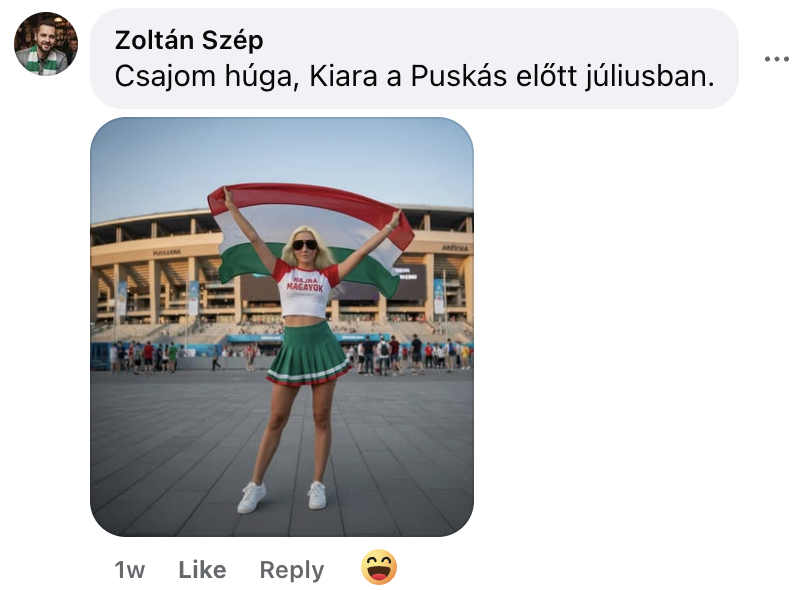
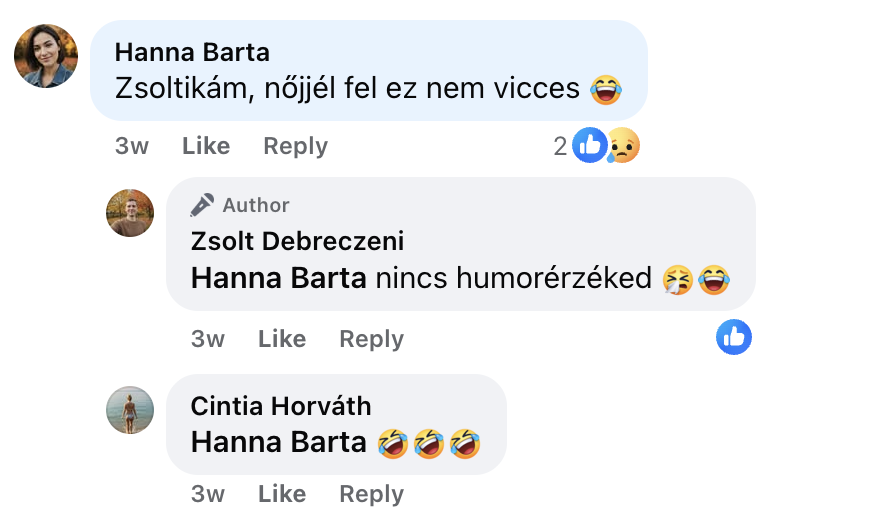
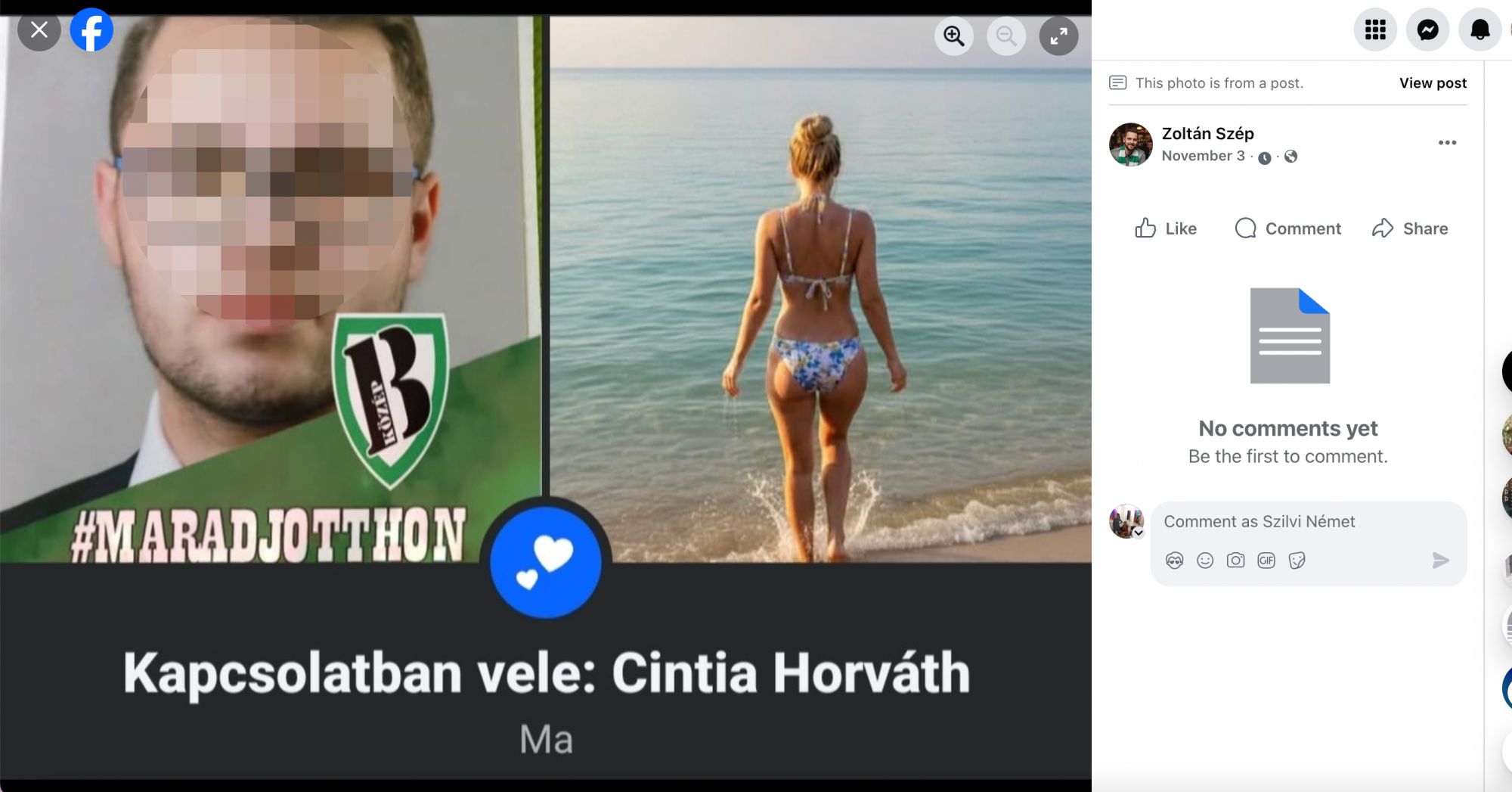
Cintia and Zoltán announced on Facebook in early November that they were seeing each other. The news spread quickly among their friends, most of whom welcomed the announcement and wished the couple happiness and, in some cases, children. But there were a few who took offense at learning about the new relationship through social media. Zoltán also revealed that he had grown close not only to Cintia but to her family as well. Beneath the announcement he posted a photo of Cintia’s younger sister, Kiara, taken outside Puskás Aréna, where she was indulging their shared passion for soccer.
A few days later came the shock. In another public Facebook comment, Zoltán wrote that Cintia had not been entirely honest with him. While they were together, she also had an affair with another friend of theirs, Benedek. Their relationship ended quickly. Cintia blocked Zoltán on Facebook, and Zoltán, in his own words, “threw Cintia’s stuff out the window.”

The story above is likely to feature no real people at all.
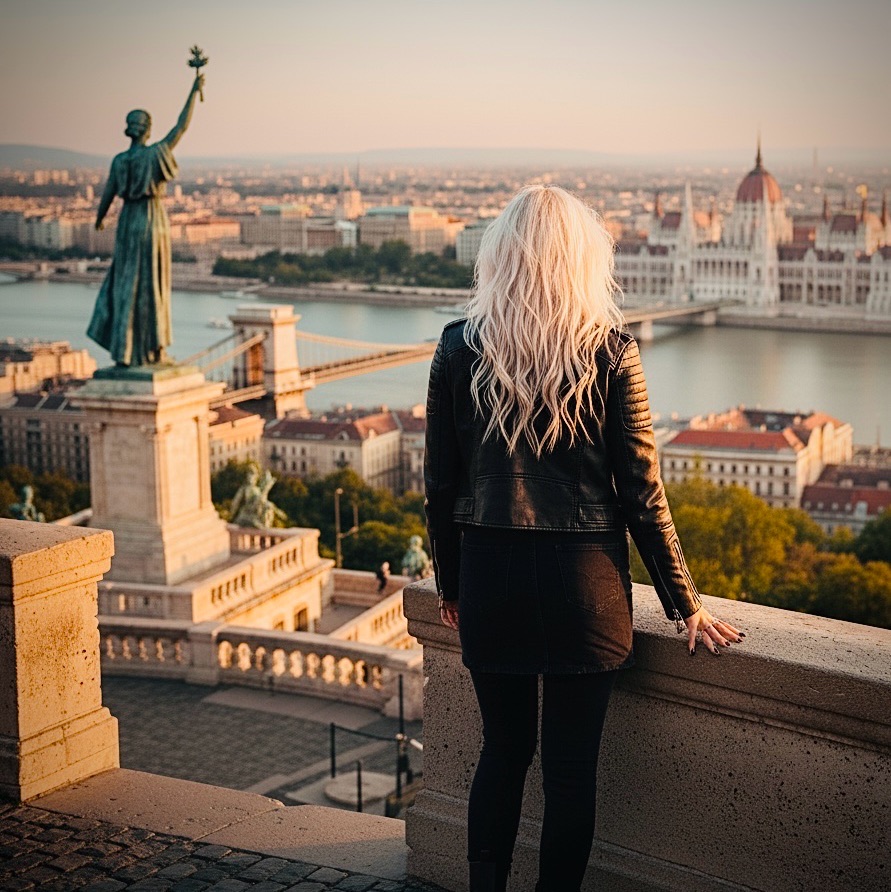
Zoltán, Cintia, Kiara, and Benedek live in an alternative reality where the Liberty Statue of Budapest holds a copper flower, where the Chain Bridge runs into the Parliament, and where a young Asian pharmacist can, without difficulty, become a middle aged businessman with Caucasian features from one day to the next.
The soap-opera-worthy tale in the introduction features characters who belong to a Facebook network that numbers nearly one hundred profiles. (We track the profiles we examined in this table.)
Their virtual personas appear to behave like ordinary people: they post about relationships, tease friends, and share family photos. Yet behind these personal stories, another purpose becomes clear. The same profiles produce and circulate pro-government content on an assembly-line scale.
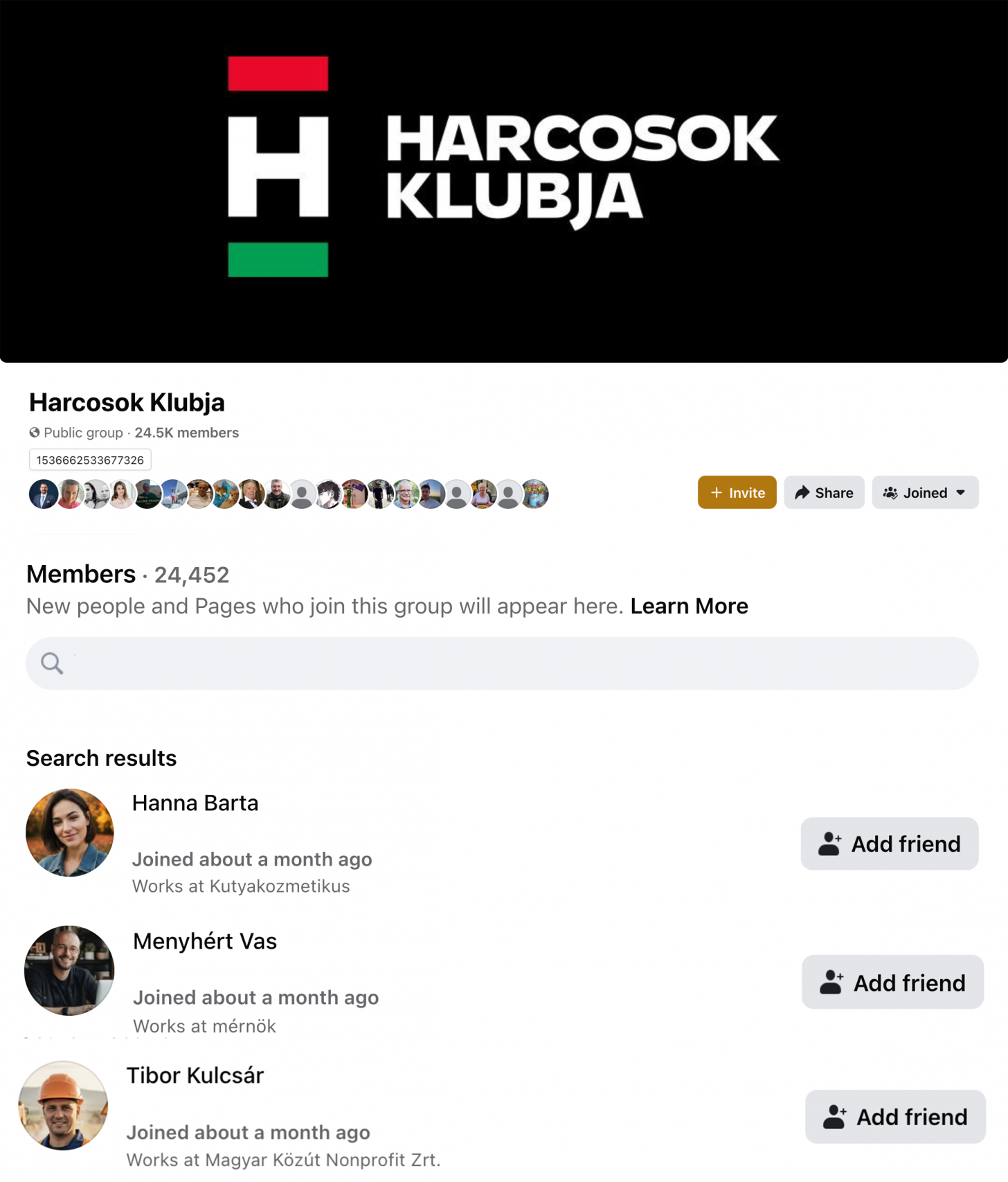
Roughly half of the network we mapped, forty-nine users in all, also belong to a Facebook group called the Warriors' Club (Harcosok Klubja in Hungarian). It is a public community that, according to its own description, supports the private Warriors' Club launched by Prime Minister Viktor Orbán. The supporter group was created in March by Balázs Szakonyi, the former Fidesz–KDNP chairman in Tapolca, and its posts are written alternately by him and a former Fidesz–KDNP candidate, István Pálinkás, who ran for mayor in Rácalmás in 2019. (The group has twenty administrators, among them Gábor Nagy, founder of the conservative news site Vidék hangjai, and Attila Hudák, who completed the Megafon social media training program in 2023.)
The unofficial Warriors' Club has grown to nearly twenty-five thousand followers, and alongside the fake accounts, its members include Bence Apáti of the National Resistence Movement, Member of Parliament Miklós Seszták, MEP András László, and analysts from the government-aligned Nézőpont Institute.
Plastic Warriors
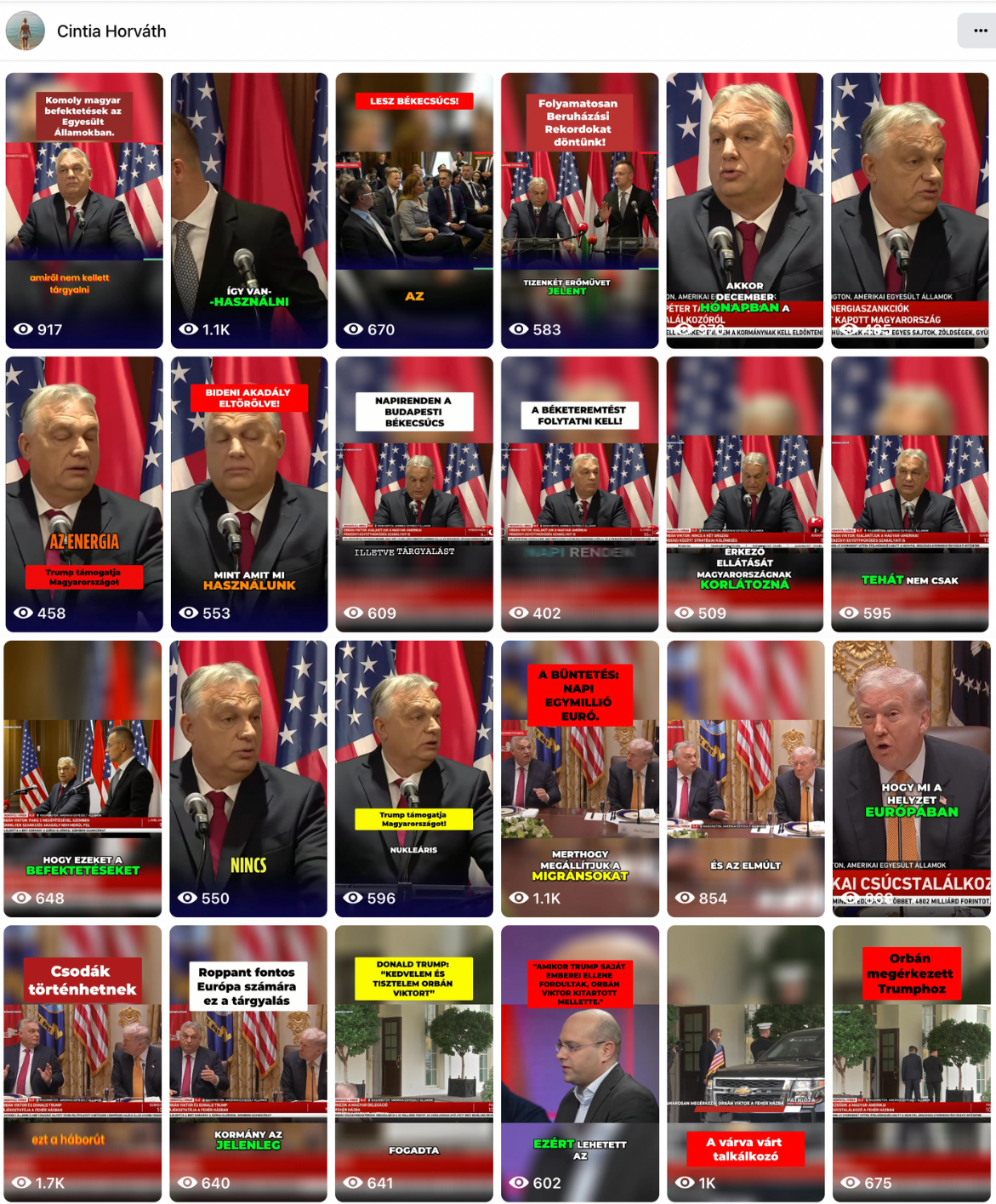
Cintia, who according to her Facebook profile is single again, was unusually active on the social media site on November 7. Between 6:30 and 10:30 that evening, she posted a total of twenty-five short videos about the Orbán–Trump meeting in Washington.
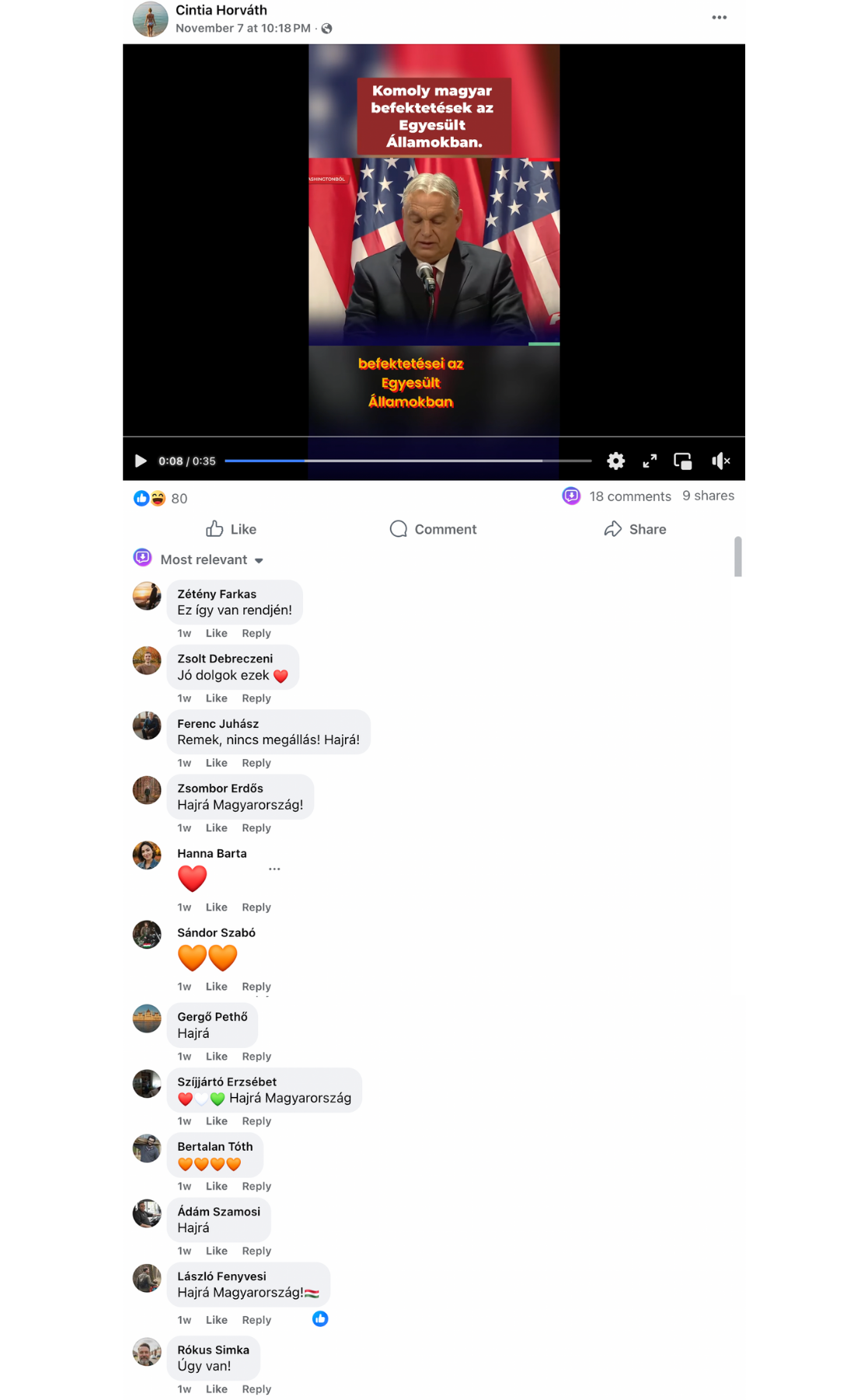
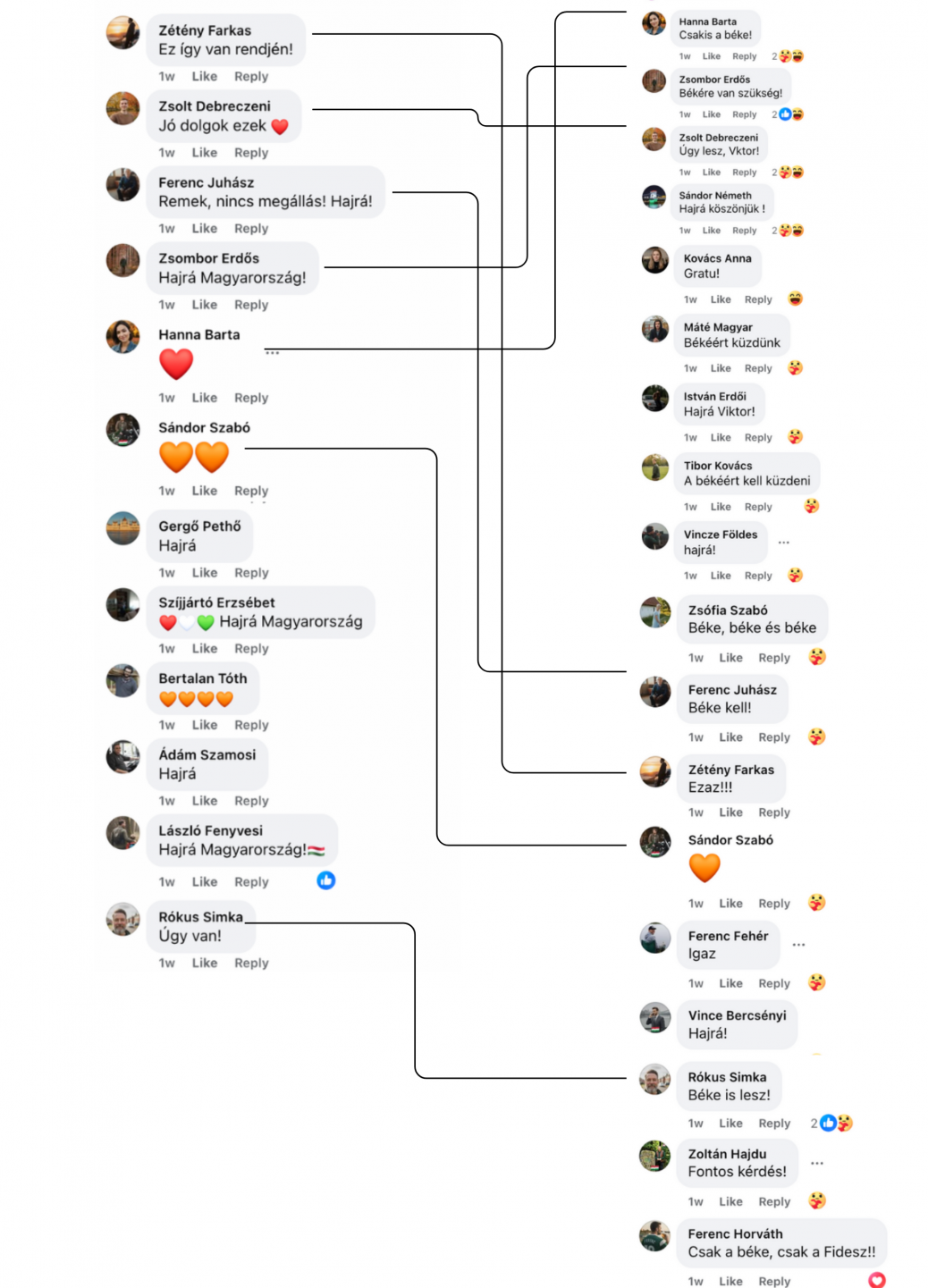
Most commenters were not surprised by Cintia’s political engagement. Many seemed to share her enthusiasm. Under the video in which the Hungarian prime minister spoke about upcoming Hungarian investments in the United States, the responses included:
“Come on, Hungary!” (Zsombor Erdős)
“Excellent, keep going. Hajrá.” (Ferenc Juhász)
“These are good things.” (Zsolt Debreceni)
“This is as it should be.” (Zétény Farkas)
🧡🧡 (Sándor Szabó)
“Come on, Hungary!” (Zsombor Erdős)
“Exactly.” (Rókus Simka)
Despite the late hour, and the fact that twenty of Cintia’s other posts touched on similar themes, the same people continued to voice their support under each one. Every agreement reached in Washington seemed to please them, whether it concerned Hungary’s gas supply, utility costs, the peace summit, or the two countries’ nuclear cooperation.
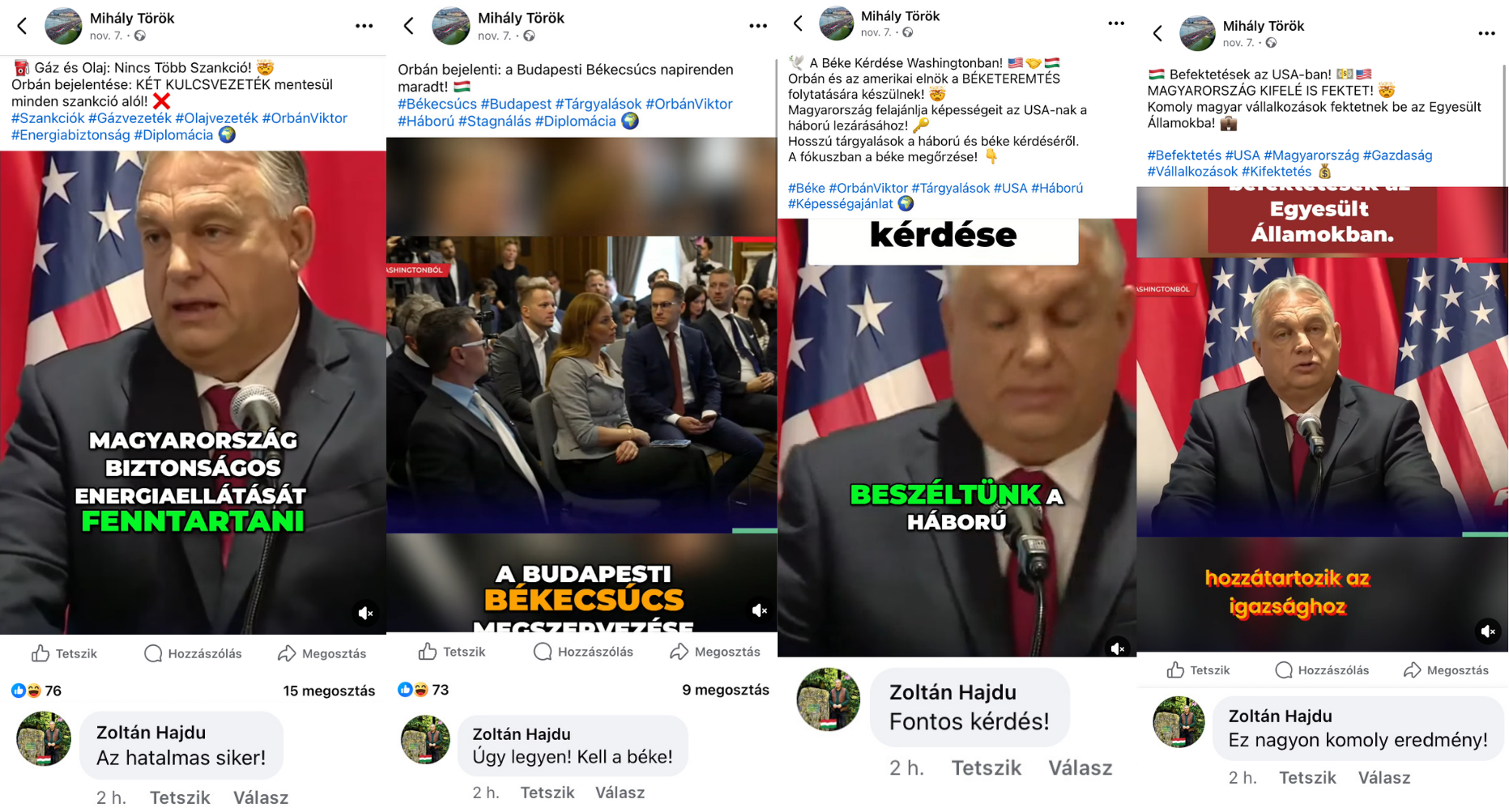
Their enthusiasm went even further. They did not limit their reactions to the videos of the Orbán–Trump meeting on Cintia’s feed. They were active on the pages of other friends as well, including Mihály, who on November 7 outpaced even Cintia by posting thirty-nine videos on the topic. The commenters kept up even when only two minutes separated the posts of their two friends.
The two cases above are only snapshots from more than a thousand political posts shared on Facebook over the past two months by members of a Fidesz-friendly network organized in early October.
We uncovered the profiles belonging to this network through a snowball method, tracing one user’s public activity to others who commented on, liked, or shared content posted by accounts we considered suspicious. (Our initial reference point was three Facebook pages flagged by one of our readers.)
The database ultimately included eighty-seven profiles that met at least three of the following criteria:
- they were created in 2025 and began posting publicly only in the past two months,
- their profile photos and image-based posts were generated with artificial intelligence,
- they show hyperactive behavior, posting and commenting on party-political topics in quick succession and in formulaic ways,
- their friends lists include other members of the network, and
- they belong to the supporter group called the Warriors' Club.
Based on these conditions, it is highly likely that members of the network appear on Facebook under false names, use fabricated identities or at least mislead others about their real appearance and lives, while they share and comment pro-Fidesz content in a coordinated way.
Zoltán, Kiara, and Cintia all meet these criteria, while the account belonging to the other man in the love triangle, Benedek, was deleted after we began collecting data. Kiara’s first public post dates to October 20, and a few days later she had already published a dozen reels from the pro-government Peace March. Under her posts we find other members of the network, as well as the former boyfriend of his supposed sister, Zoltán, whose profile photo was taken from a real person and then enhanced with artificial intelligence.
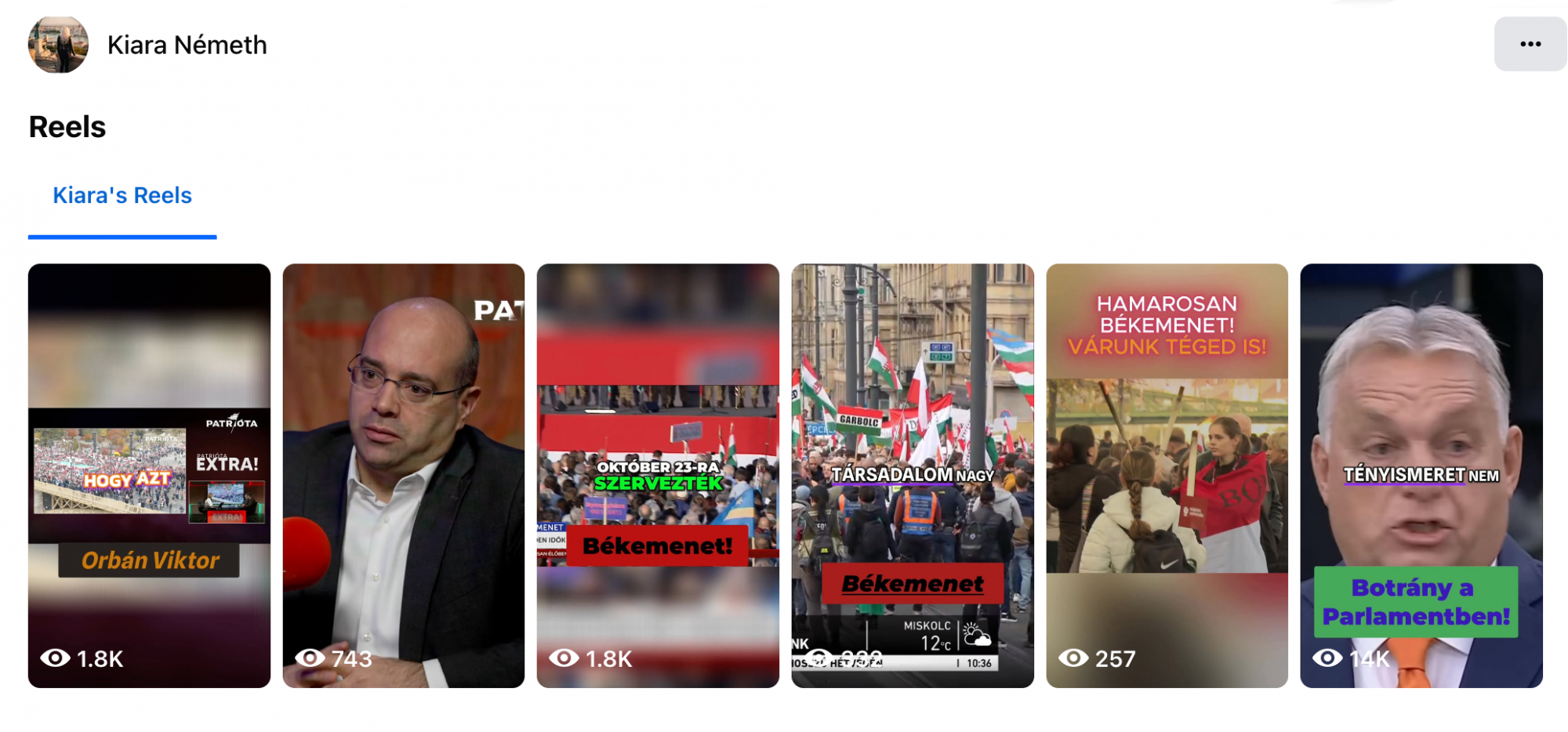
Beyond the Orbán–Trump summit and the Peace March, this alternative distribution network also helped amplify other public events important to Fidesz, including Orbán’s speech in the Strasbourg parliament, the Digital Civic Circle gathering in Győr, and Egon Rónai’s interview with Viktor Orbán. The results were not insignificant. Several posts drew between two thousand and forty-five hundred reactions in rapid succession.
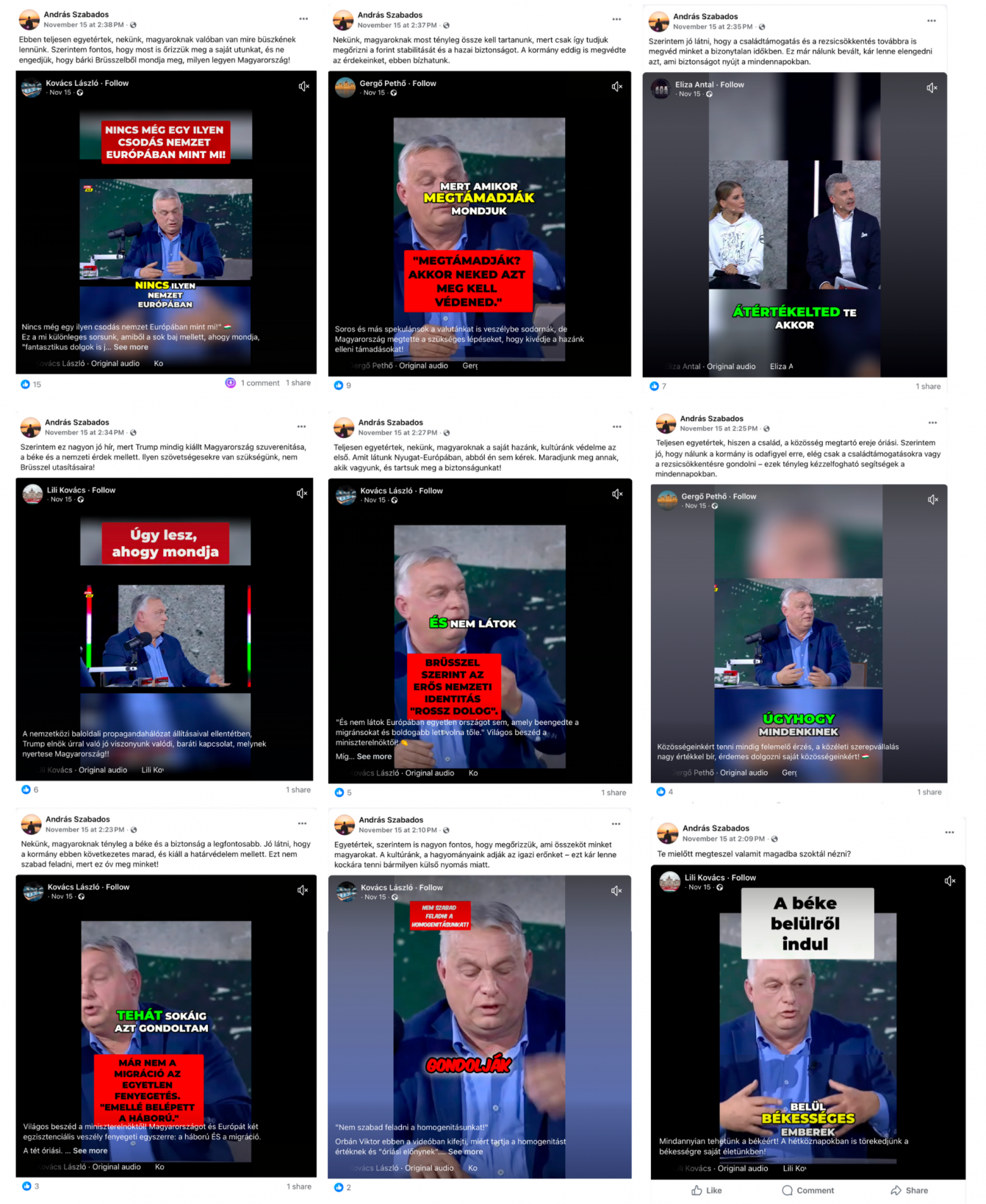
The most active members of the network are Mihály, László, Eliza, and Lajos, who all appeared with public posts on the platform in mid to late October and immediately joined the Warriors' Club. During their brief careers they each posted between 120 and 140 times, sharing short reels cut from the videos of pro-government content creators. The reels are repackaged versions of existing videos, highlighting the most striking quotes.
(The importance of reels-videos circulating on Facebook was most recently emphasized by Magor Dukász, a Fidesz strategist during the Warriors' Club training camp in Zánka. “Facebook reels have exploded,” he said, adding that the 2026 campaign will revolve around them.)
The material used by the fake-profile network spans the entire pro-government media ecosystem, from state television broadcasts and live videos by Fidesz politicians to the Patrióta channel run by Megafon on YouTube. Even platforms such as Ultrahang, a program focused on foreign and security policy, and Narancskommandó's trashy commentary are part of the mix.
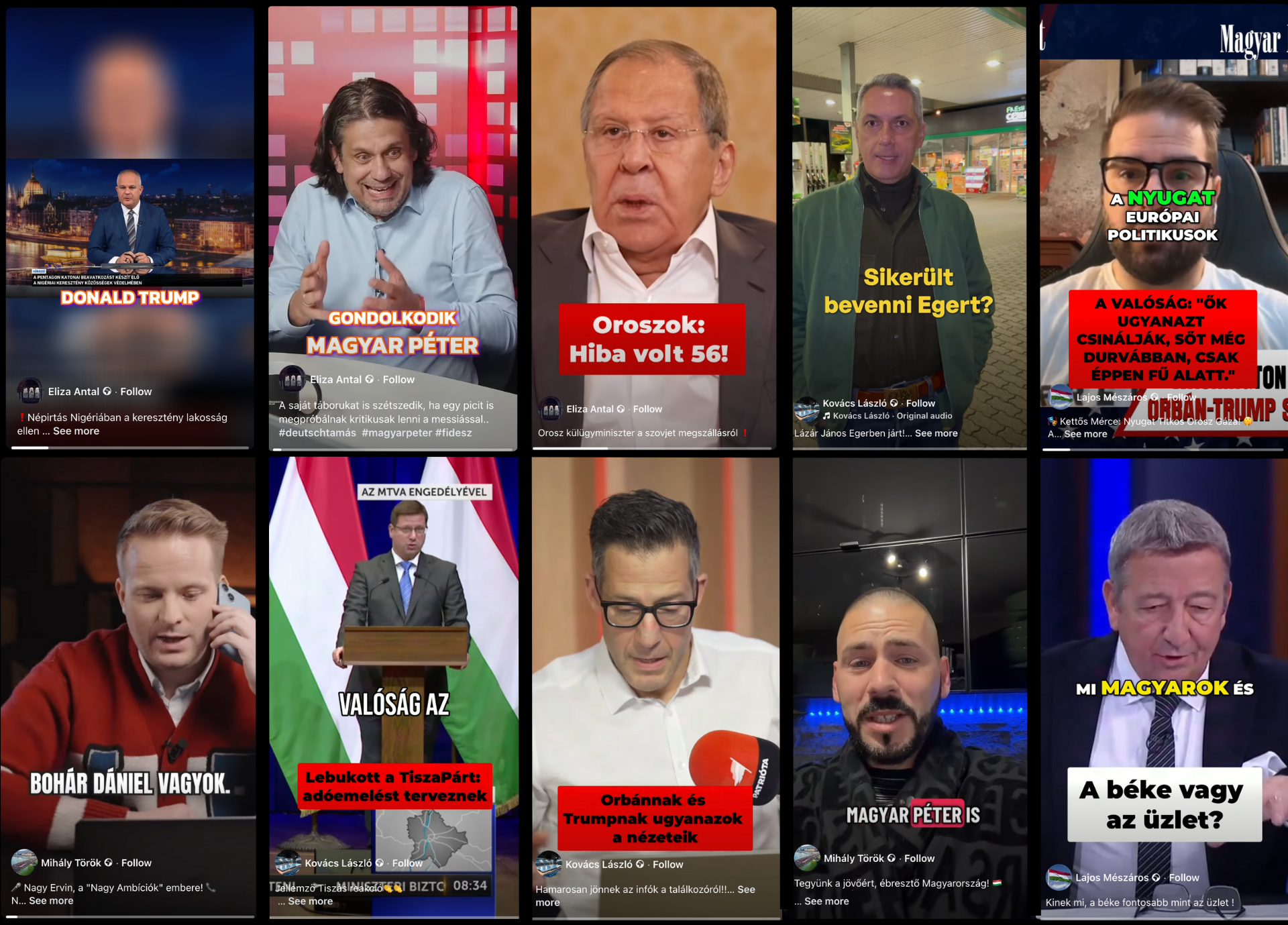
Interestingly, members of the network do not share the videos from the official pages of the original creators. Instead, they appear to download the footage, reedit it, add captions, and publish it under their own profiles. When we checked one video from Magyar Nemzet against the version circulated by profiles linked to the network, we found that the latter presented the same material in a more direct and more strident form.
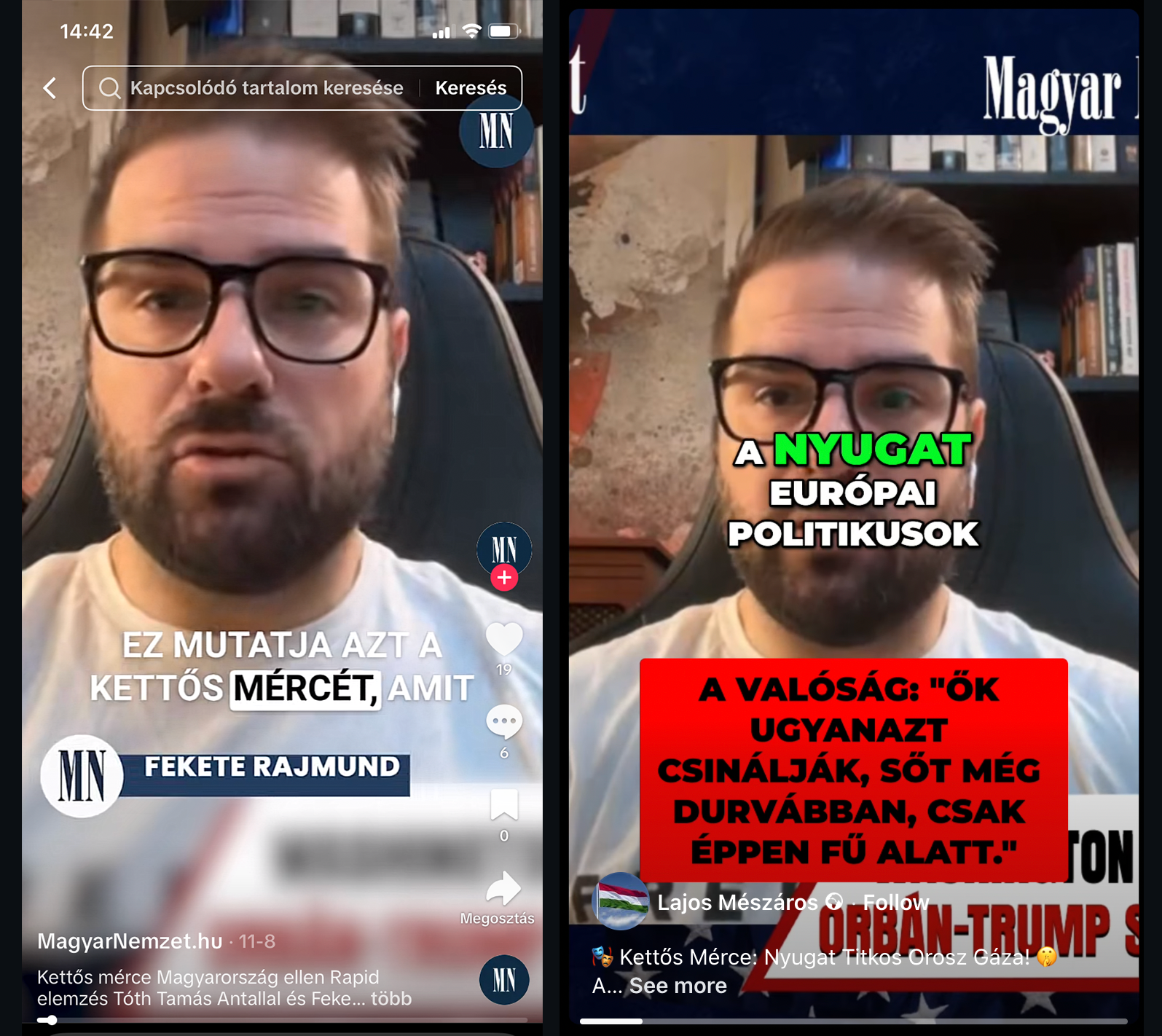
right: Lajos Mészáros’s Facebook page.
A well-chosen video clip can travel far beyond the network's own bubble. Mihály, who has 1,800 friends on Facebook, drew 3,200 likes, 257 shares, and 119 comments with his most viral post.
This is not the botnet we were waiting for
Since Fidesz’s digital presence gathered new momentum, analysts from Zoltán Lakner to Csaba Molnár have raised the possibility that the Warriors' Club and the Digital Civic Circles could also serve to mask information operations carried out by bot networks or fake profiles. Official estimates suggest that more than 150,000 people have already joined the two initiatives. The Warriors' Club now counts nearly 50,000 members, while the Digital Civic Circles list 104,000 on their website.
Photos from offline events show that the governing party can present real flesh and blood activists. They do fill stadiums, so they exist, even if they are mostly older Fidesz supporters less familiar with political marketing. Yet several analysts who spoke to 444 predicted that the hype surrounding the Warriors' Club and the Digital Civic Circles could easily obscure a later intervention carried out with automated technology, potentially even from abroad.
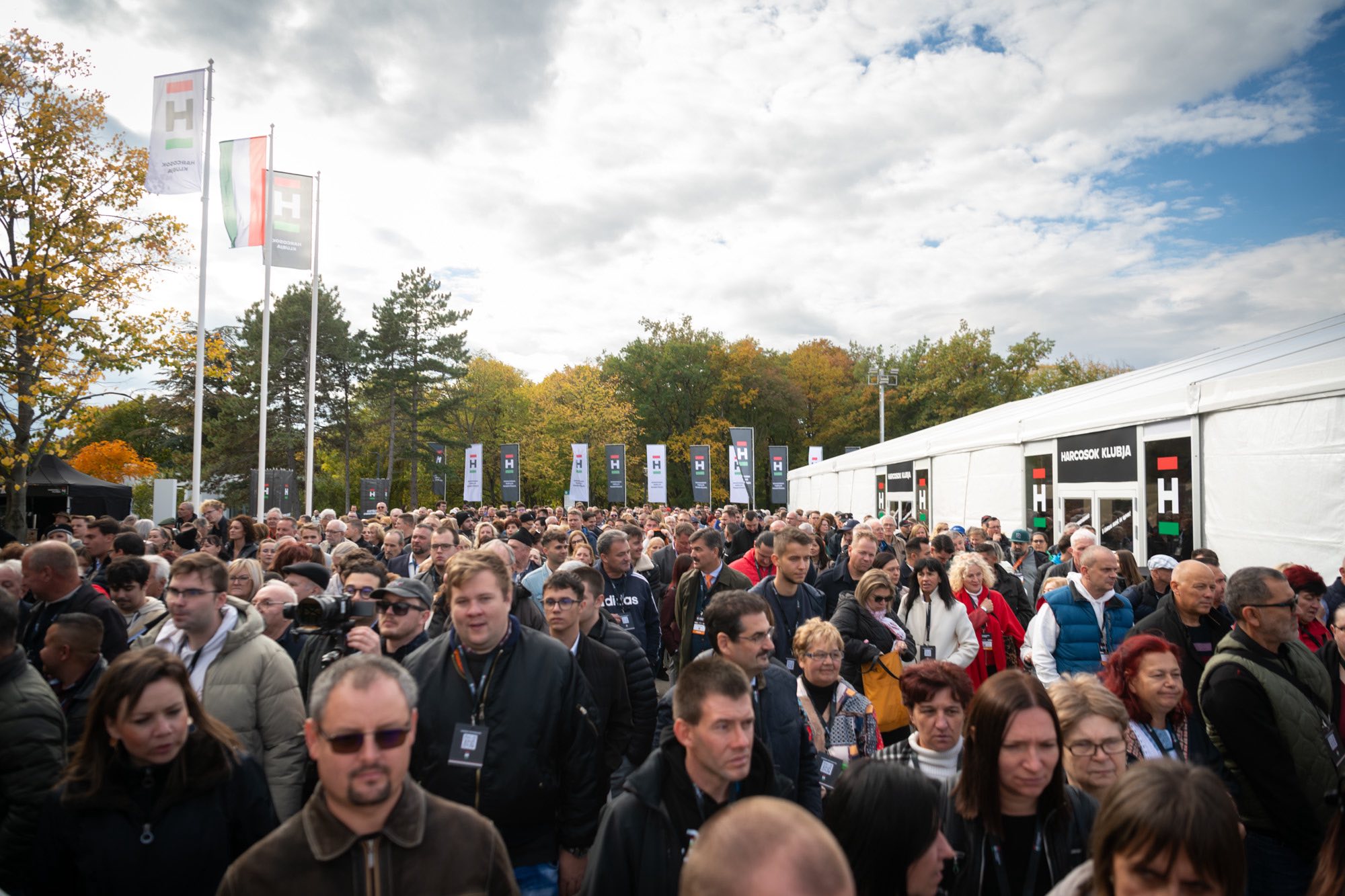
By contrast, for now we have run into something quite different: a network of nearly one hundred accounts that sits somewhere between digital work powered by human labor and purely technological solutions. The profiles appear to be operated by real people, though likely not the individuals they present themselves as on Facebook through AI generated simulations.
Cintia, for instance, is probably not a Fidesz activist whose official documents bear the name Cintia Horváth and who looks exactly like the person shown on her Facebook profile. There may well be someone who supports Fidesz by posing online as Cintia, and possibly at the same time as Zoltán or Kiara, in order to comment on, like, and share pro-government content in their names.
Because this is done in a coordinated fashion as part of a network of fake accounts that echoes nearly identical messages, their activity fits Facebook’s definition of coordinated inauthentic behavior, which the platform prohibits. It is perhaps no coincidence that some profiles have already been removed.
Although the profiles cluster in a Facebook group that supports the Warriors' Club, it remains unclear who exactly is behind the network. The timing of the posts suggests that whoever manages the profiles is most active during working hours, between 9 a.m. and 7 p.m.
These accounts represent an entirely new level of sophistication in their construction, their operation, and the digital storytelling woven around them.
Characters built with this degree of precision have been rare in Hungarian public life, which means it is time to rethink what we learned from the usual “how to spot a troll” primers:
- It is no longer a matter of scanning profile photos for extra fingers or crooked eyeglass frames, and tools like the thispersondoesnotexist generator are already outdated. New generation AI systems work at a far more advanced level.
- The old rule of thumb that suspicious profiles can be exposed by their small number of friends also no longer applies. Cintia, for example, has 1,200 friends, Mihály has 1,800 followers, and across the network the average is well above one thousand.
- Nor can we say that these accounts share only occasionally a cute animal photo to seem more believable. Instead, they have lives and identities of their own.
But what exactly are those? To answer that, we need to explore the wide circle of friends around Cintia and Zoltán.
Fradi, fishing, and no social media. Until now:)
Cintia’s sister, Kiara, already appeared in the introduction as a football devotee. She leaves no doubt about her passion. In a November post, she poses in front of Puskás Aréna dressed head to toe in the national tricolor. Although several small clues in the image suggest it was generated by artificial intelligence, such as the misspelled “hajrá magayok” text on her shirt, some commenters still believed she was real. One even wrote that Kiara is a “Real Hungarian Girl,” which is why they accepted her friend request.
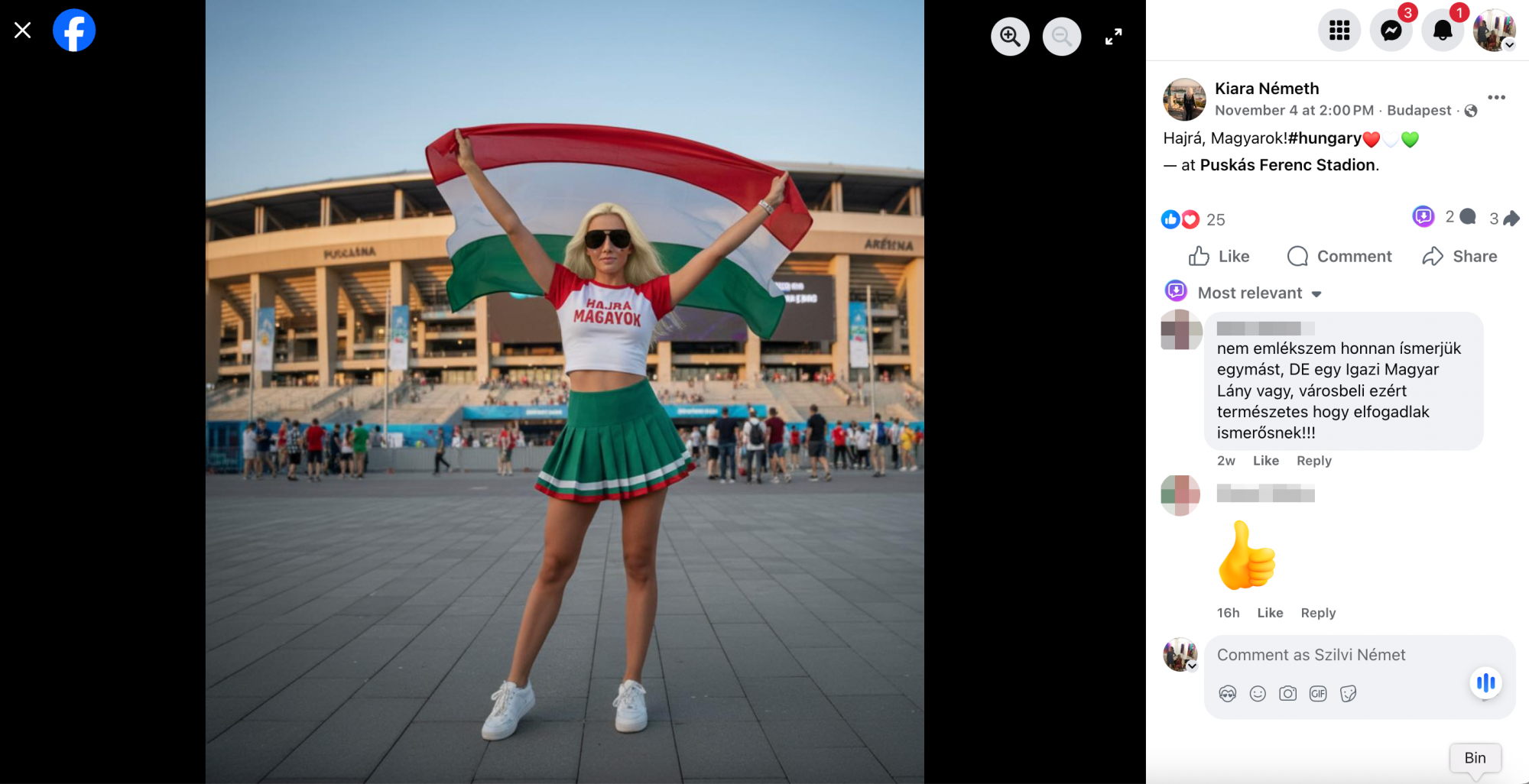
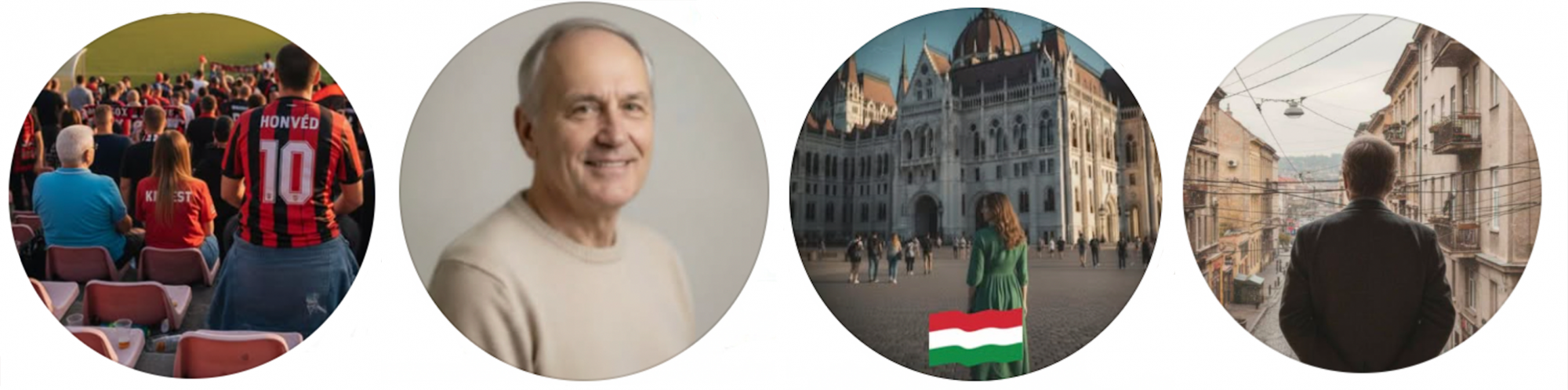
A similar method drew Facebook users to many other profiles in the network, whose lives also appear to revolve around football. Most cheer for Fradi, but there are fans of other Hungarian football teams such as Honvéd, Diósgyőr, MTK, and even foreign ones like Lazio and Liverpool.
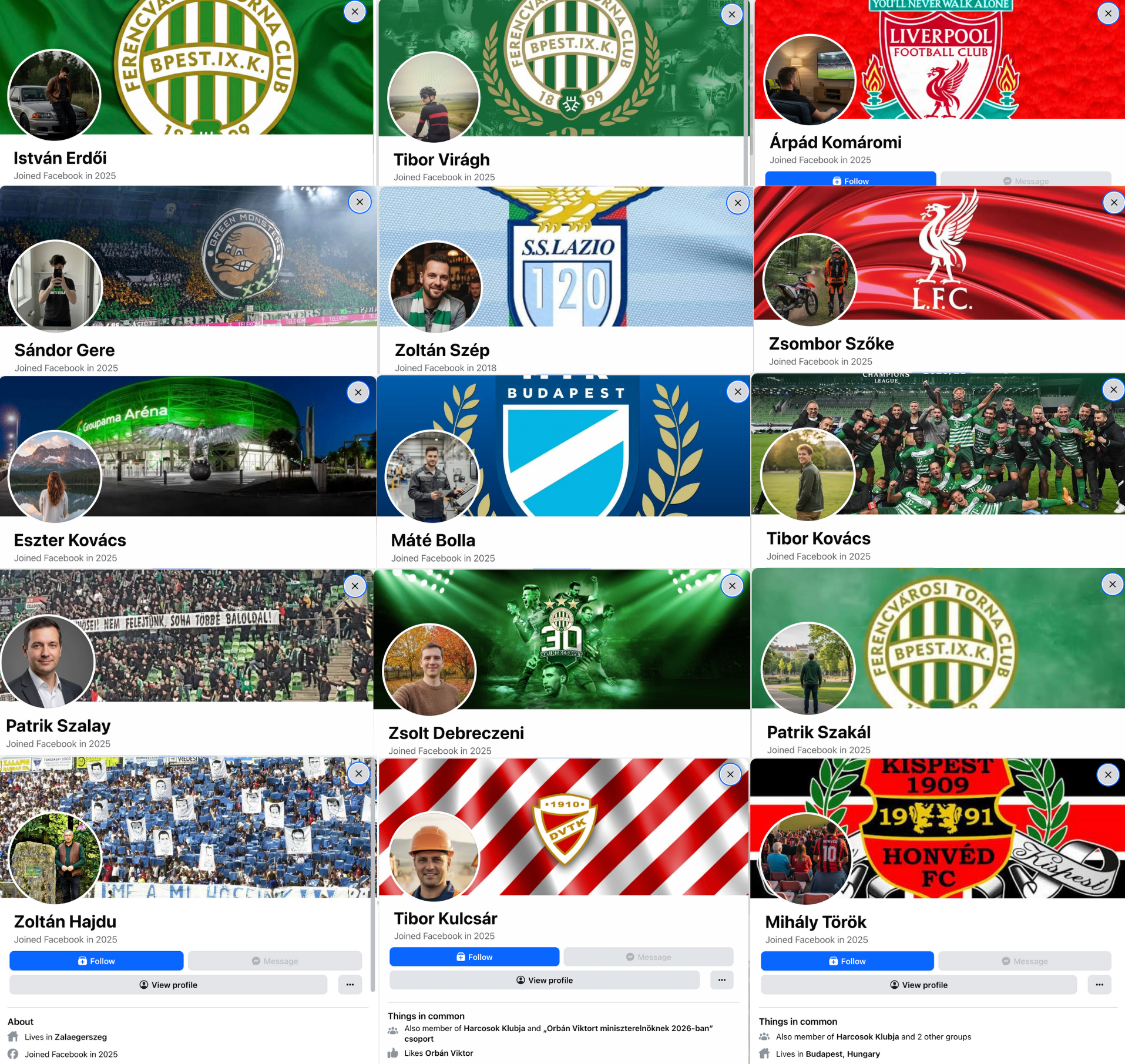
Although most of the profiles use AI generated faces, there was at least one case, involving Zoltán mentioned in the introduction, where a photo of a real member of B Közép, one of Ferencváros’s best known supporter groups, was stolen and later altered with AI.
“It seems very suspicious to me that some fan group connected to Fradi was used for this, because the common point between me and the fake profile is that we are both members of such groups”
the man said after we showed him the fake ultra profile that continues to use his image misleadingly.
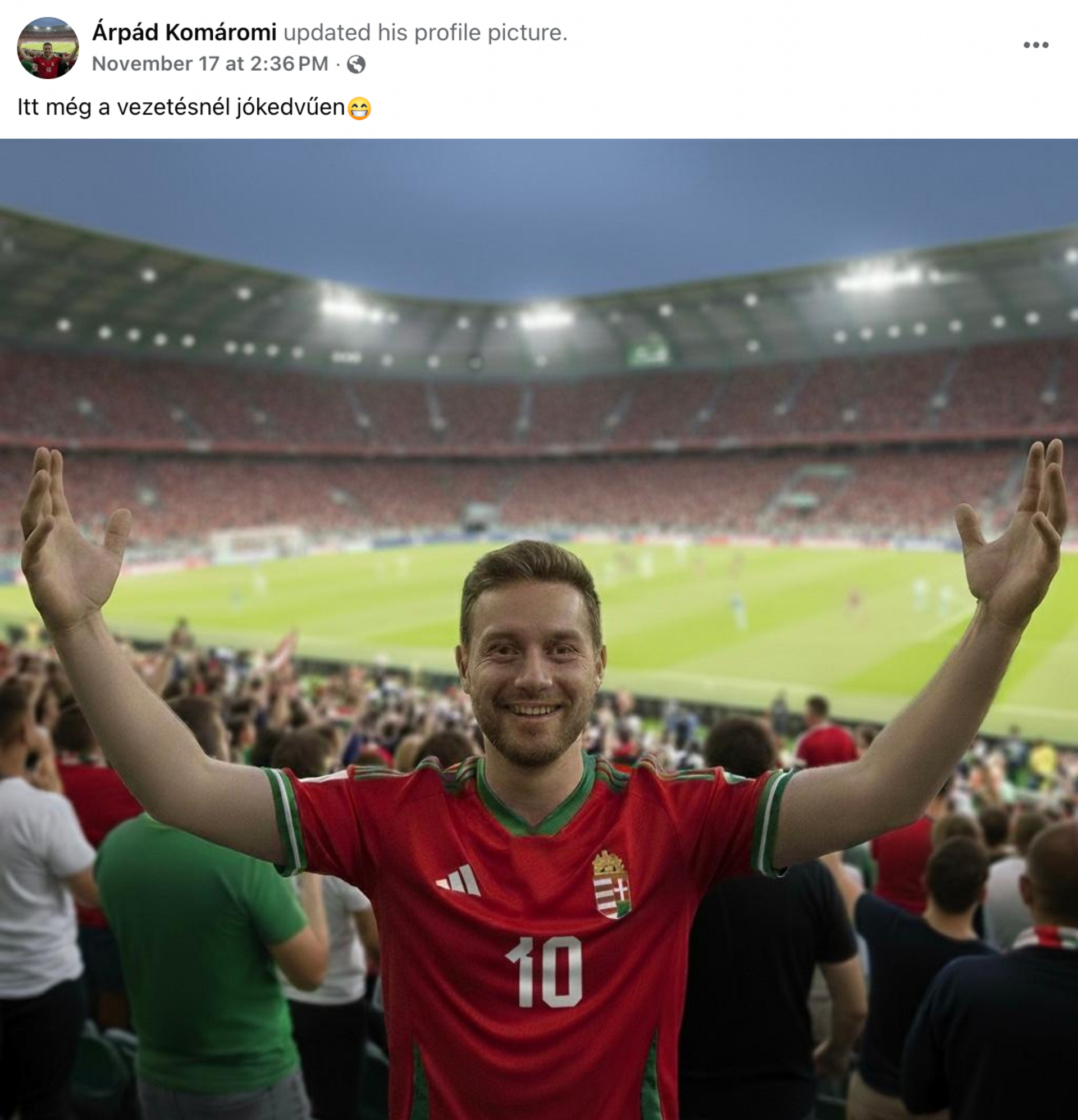
The accounts that rely on football follow the same template. Their cover and profile photos already signal the theme through team logos, jerseys, terraces, or stadiums. The subject also gives them something consistent to post about. Their feeds are filled with football news, insider snippets from fan groups, and occasional greetings to fellow supporters accompanied by photos that show signs of AI generation.
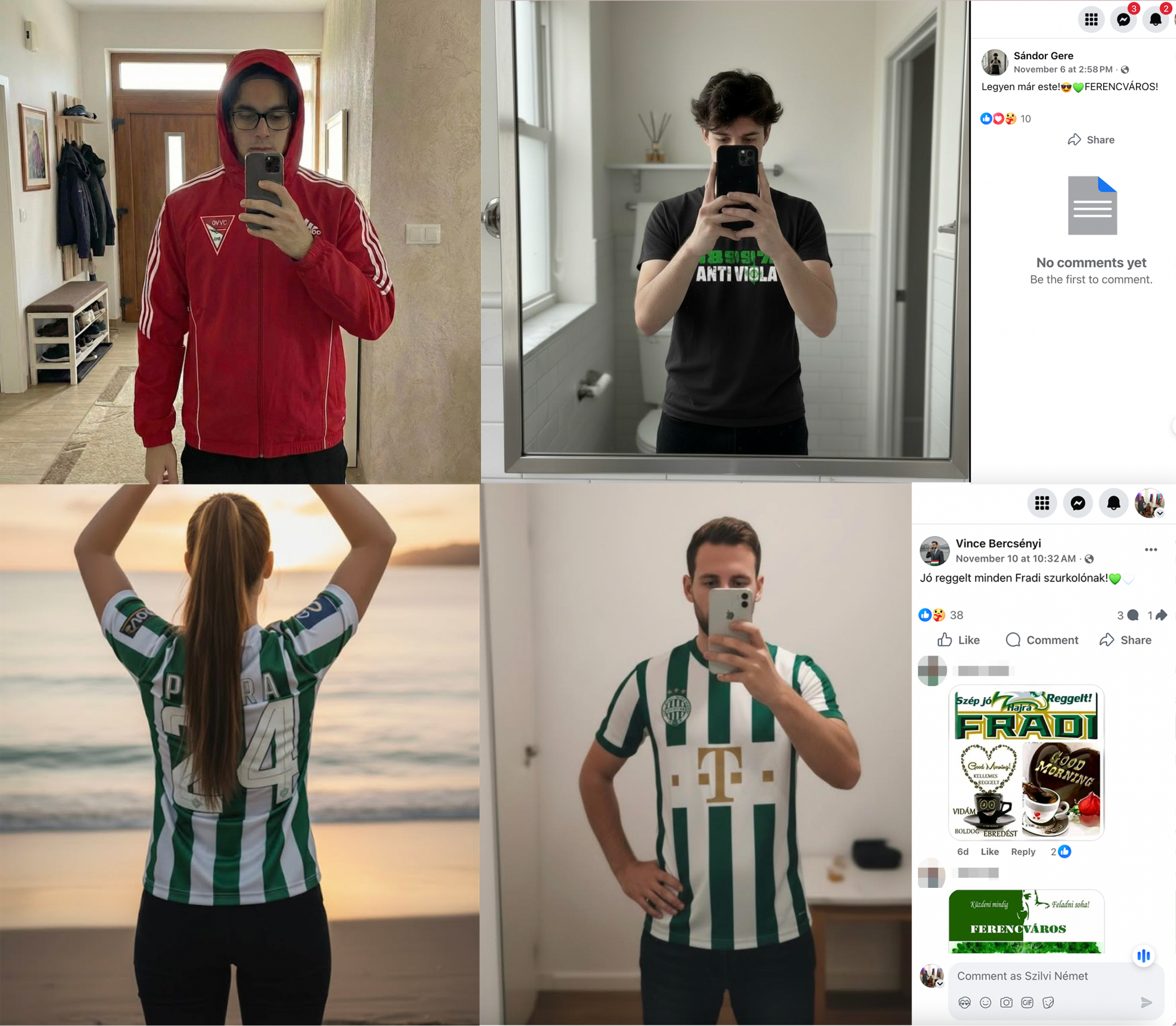
Their friend counts show how effective a well chosen theme can be. In Hungary, football is not only the national sport but, in the words of Prime Minister Viktor Orbán, part of the Hungarian identity. Celebrating a goal by the national team together, or mourning a defeat, creates strong emotional bonds and builds a sense of community even among strangers.
Once that foundation is set, the more political material can follow.
Sándor’s feed is a textbook example of this gradual buildup. Between October 28 and November 7, he posted only football-related content. After his seventh post, he switched topics and introduced the Győr meeting of the Digital Civic Circles, dropping in seventeen reels at once. Videos featuring Márton Békés, Philipp Rákay, Zsófi Szabó, and, of course, Prime Minister Viktor Orbán have since disappeared from his page, but we saved them in time. It was not the only instance of posts being removed once a topic had run its course, as the network’s members routinely deleted such content from their timelines.
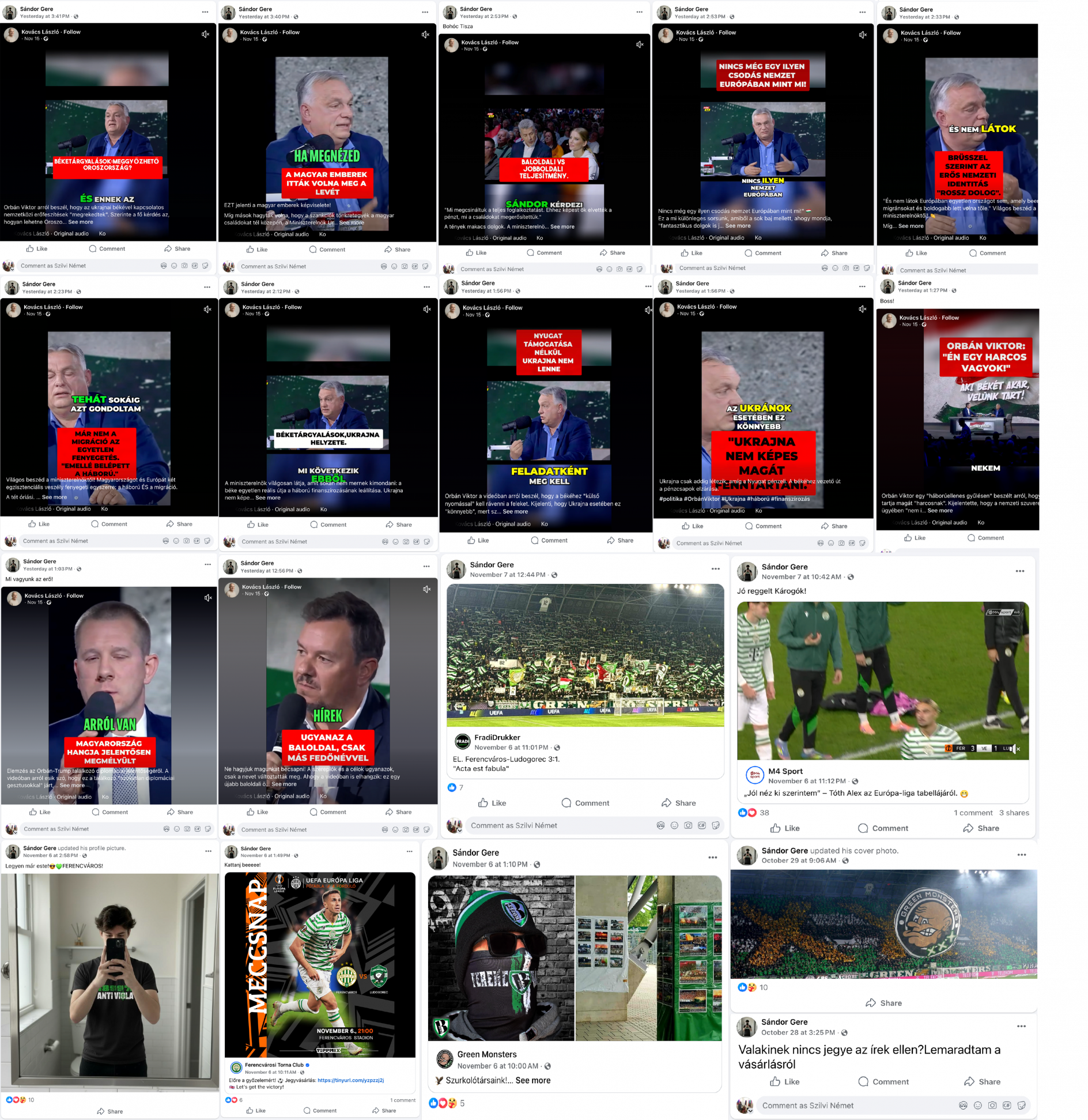
Sándor also plays the role of a young Fidesz voter on others’ feeds, chiming in with comments like “Orbán is a legend” or “dad is right,” in a style that matches the persona.

Alongside football, the other favorite pastime of these fake profiles is fishing.
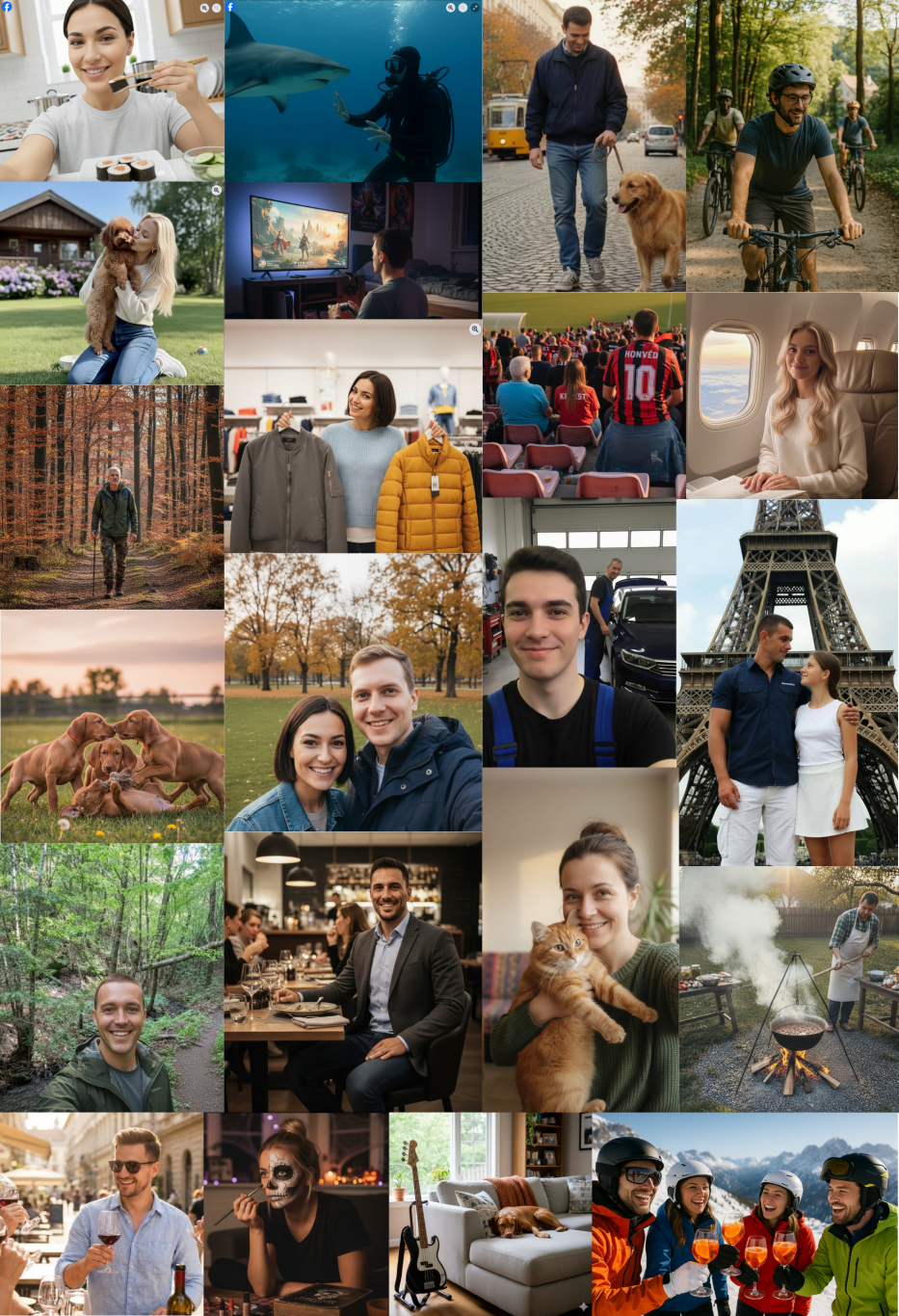
They also eat and drink, go to work, walk their dogs, pick mushrooms, hike in the Bükk hills, fall in love, raise children, prepare for Halloween, dive, drive, cook, take vacations, build models, work in the garden, play video games, go shopping, and fly abroad. In other words, they behave exactly like real people.
Anyone else joined in 2025?
While the operators of the profiles try to make their activity look authentic, one thing is hard to hide with photos and links: how long someone has been on the platform.
Almost every Facebook profile in the network we uncovered was created in 2025, with the first public posts appearing this October, between the Peace March and Orbán’s visit to Washington.
We confirmed this with a simple trick. A profile’s registration date can be checked by searching the user’s unique ID number, which appears after the equals sign in the Facebook URL, on Facebook Marketplace.
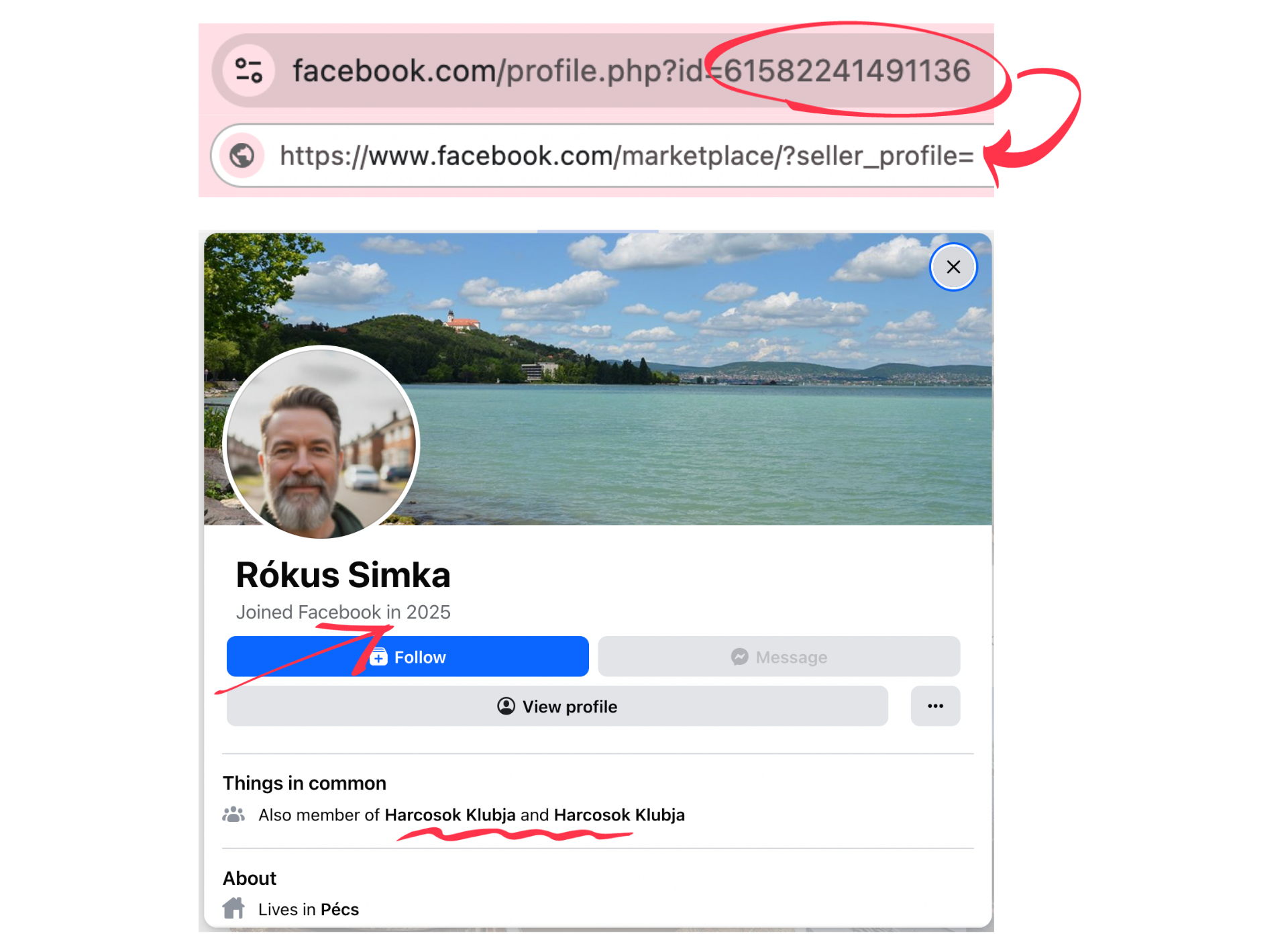
Although only the year of joining is visible there, anyone looking for a more precise date should scroll back to the very first public posts on a profile.
For Rókus, that date is October 15, when he uploaded a cover photo of the Tihany Peninsula. He offered no explanation for why he began posting on the platform only now, more than fifteen years after Facebook became available in Hungary. By contrast, we found dozens of profiles in the network whose creators felt the need to clarify this point.
Some claimed that their previous profile had been
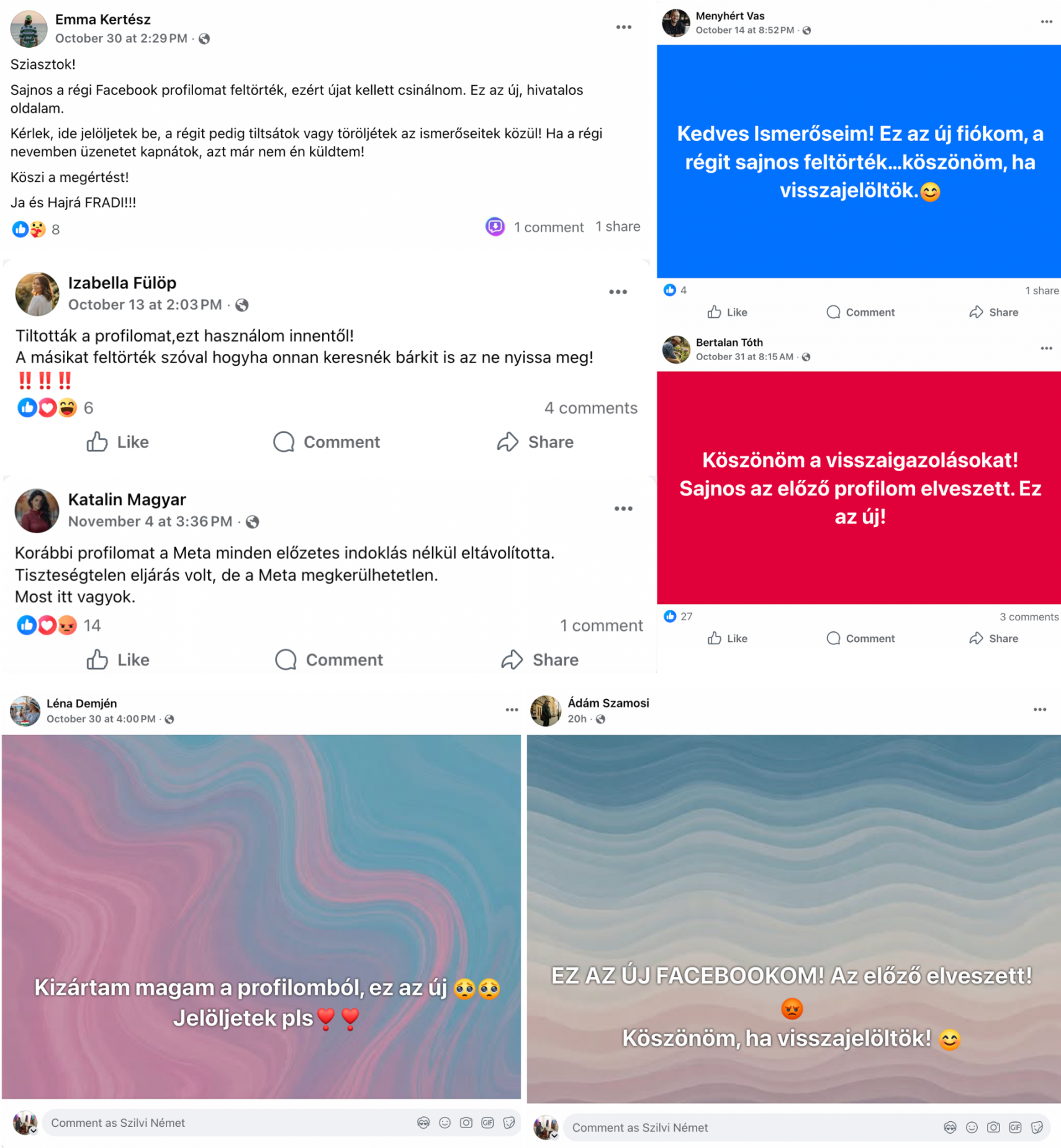
Others noted in their introductions that they had never been on social media before.
“Recently got an FB page, but only because I love fishing and it looks like there are lots of anglers here,” wrote Patrik, who appears to live with his family in Szigetszentmiklós, though he surfaced in our network because of his repetitive comments.
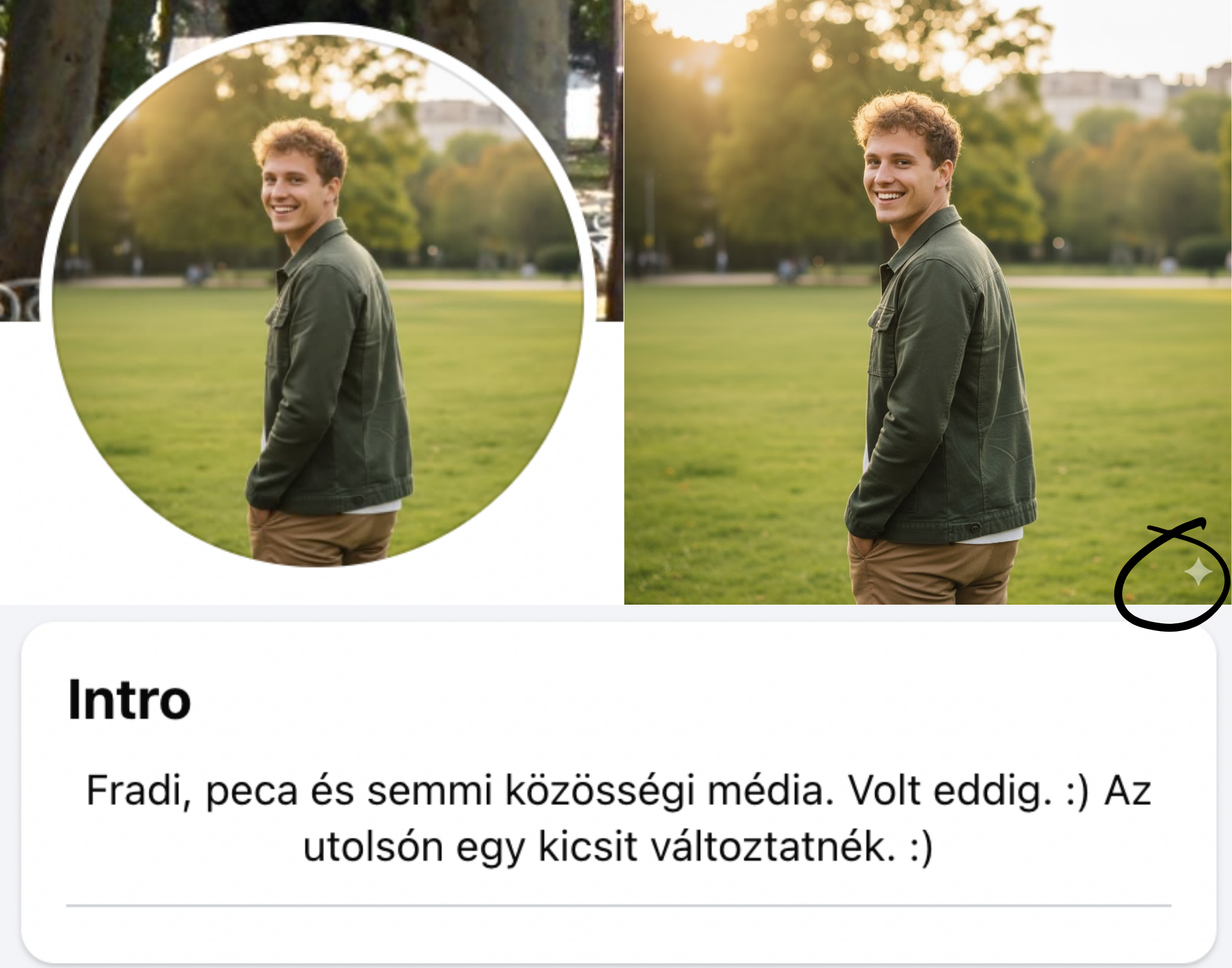
Tibor, a younger fishing and football fanatic, posted this:
“Fradi, fishing and no social media. Until now :) I would tweak that last part a bit. :)”
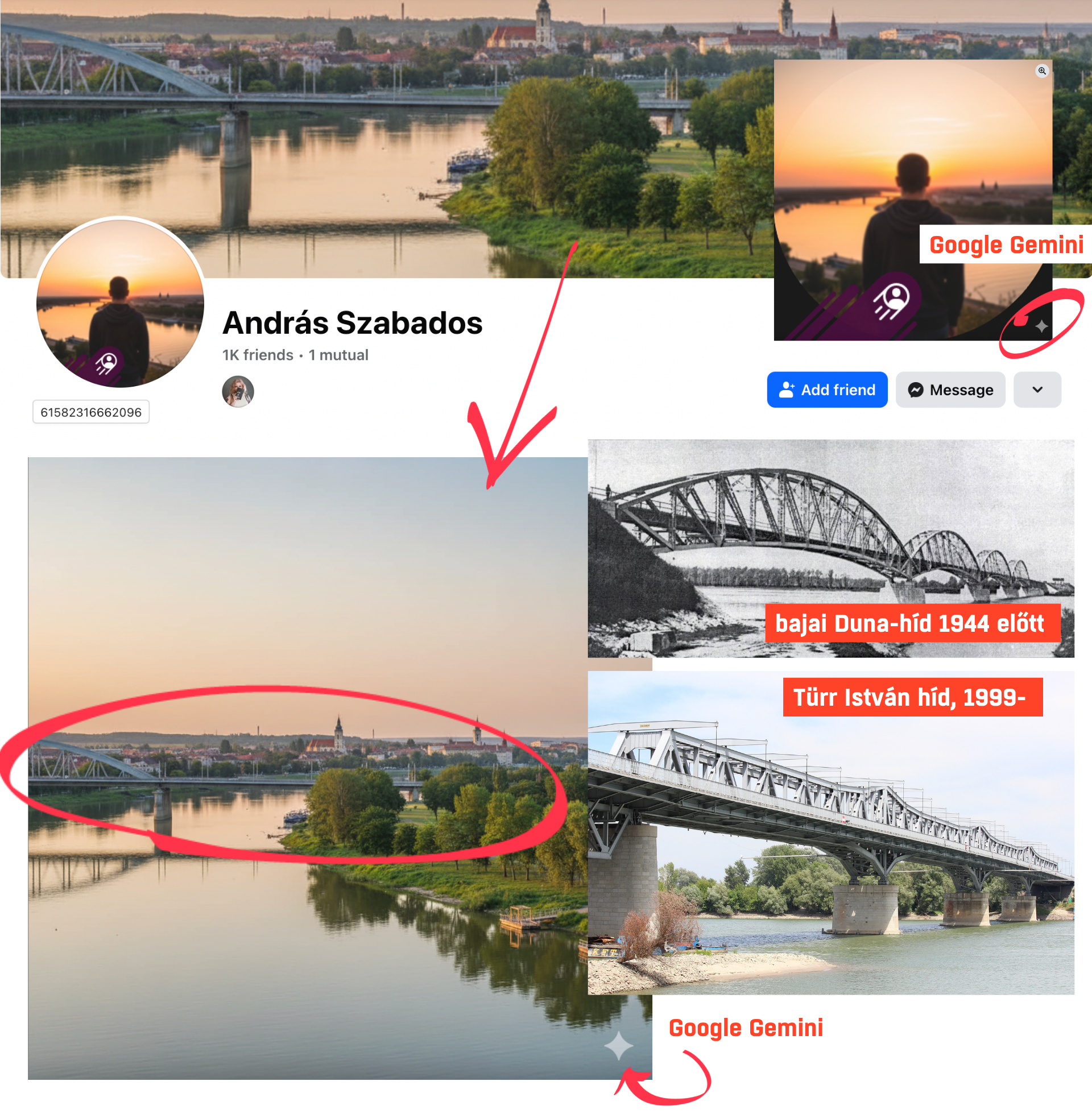
Digital detox may be trendy in 2025, but the Google AI assistant logo in the lower right corner of his photo casts this excuse in a different light. The star-shaped watermark of Google Gemini is often hidden by Facebook’s circular profile frame, so it is worth clicking through to view photos at full size.
The beginning of a beautiful friendship?
Since Facebook suspended paid political advertising in Europe, citing the EU's new transparency rules, personal networks have once again grown in importance. Through them, political content can reach users who would not necessarily seek it out on their own.
This is why it is crucial for an inauthentic network to have its members actively build connections with real users. If only fake profiles interact with one another, the impact is negligible.
I have seen this method work in my own circles. Several suspicious profiles managed to draw in not only my friends but even one of my colleagues.
Zsuzsi contacted András because of the October 20 protest organized by students at the Budapest Business University (BGE). The event was posted by an anonymous Facebook page called Free BGE, but for a long time it was unclear who was behind it. “Since the page editors didn’t respond, I wrote to a few people who appeared among the page’s friends, including András,” Zsuzsi said. “I wanted to follow the events, so I reached out. He accepted my request quickly and saw my message, which has since disappeared. I don’t really understand why.”
On October 22, András’s profile shifted into professional mode, and the content of his posts changed completely. While he had previously shared memes about university life, on November 15 he posted thirty one reels from the Győr Digital Civic Circles meeting in a single day, roughly one every minute.
It is hard to determine whether András’s account once belonged to a BGE student and was taken during the shift to professional mode, or whether it was a fake profile from the start whose operators capitalized on the momentum of the campus protest to gain new friends.
Switching to professional mode in itself does not threaten the integrity or security of a profile. The feature allows users to build a public presence from a personal account and, in some cases, even earn money from their content. At that point the profile functions in some ways like a Facebook Page: anyone can follow the posts without being a friend.
It is important to note, however, that any new feature, including professional mode, can create opportunities for bad actors to send scam messages in Facebook’s name. These often look like official notices and are designed to extract personal information or gain access to the account.
In analyzing the network, we also encountered less harmful but still deceptive and manipulative methods of friend gathering.
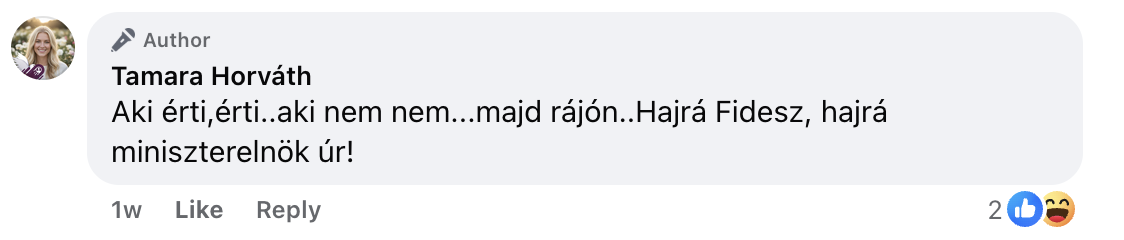
The profiles of the platinum blonde Tamara, Vanessza, and Fanni are not only attractive but deploy sexual appeal for effect, often posting so-called thirst traps. And it is not just the women. Another acquaintance of mine accepted a request from a tall, dark haired profile named Bertalan because, as he put it, “there are trees and puppies on his profile, and those are my weaknesses.”
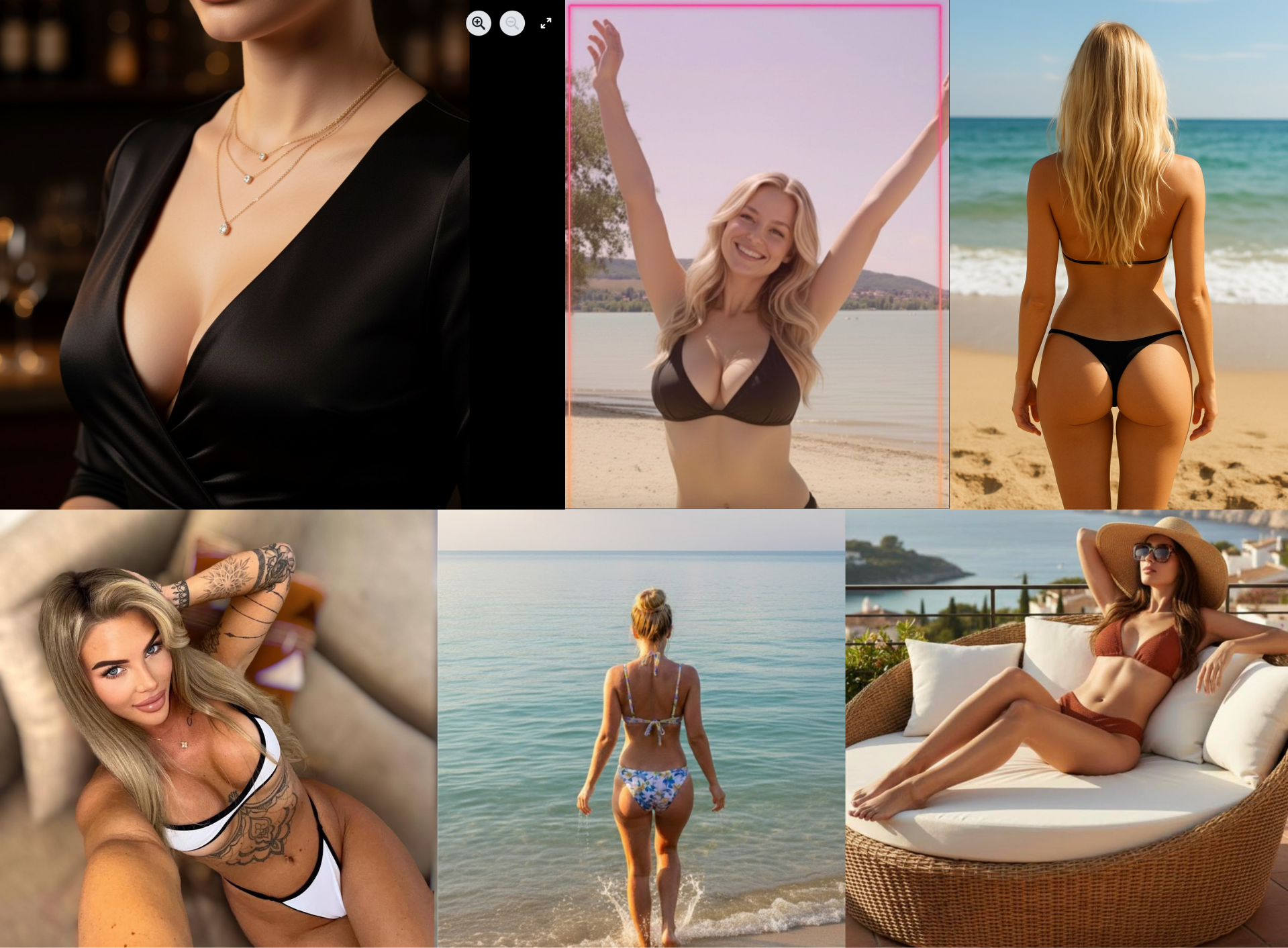
We will not speculate on whether pro-Fidesz content goes down more easily when mixed with soft erotica. What is clear is that on November 7, Tamara boosted the visibility of Orbán’s visit to Washington with thirteen videos while actively commenting, much like Bertalan.
Another friend of mine was pulled in by a member of the network through shared connections. “He probably knew it would be easier to get accepted if he started adding people within a specific circle. That is why I accepted his connection request too. We had nearly a hundred mutual friends in literature, and I usually assume that means someone is an aspiring writer, because many reach out that way. Out of simple courtesy I tend to accept those requests,” my friend said. He has since cut ties with Vincze.
We found the boldest case of friend fishing in a Facebook dating group. These groups have recently flooded the platform, and the algorithm now recommends their content even to users who never joined them. In one such open group with 33,000 followers, Zoltán (not the one presented in the introduction, who threw Cintia's stuff out of the window, but another Zoltán) posted the likely AI-generated photo below, which drew 1,100 likes and nearly 200 comments, accompanied by the invitation: “Add me and we’ll talk!”
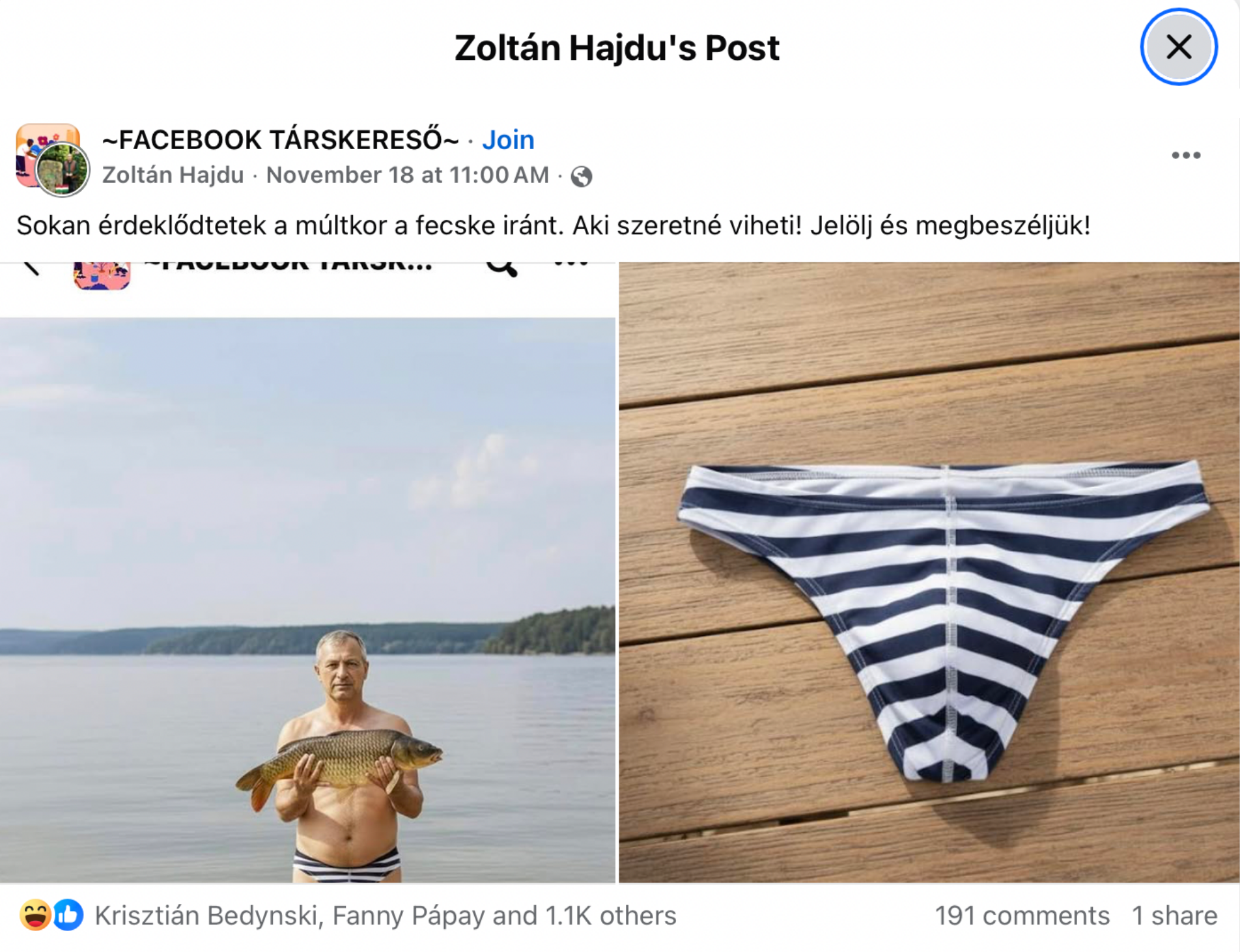
Zoltán’s authenticity is further undermined by the fact that he previously used a profile picture now displayed by another member of the network, Béla.
Within the network, Zoltán’s profile is used mainly to post comments that boost the spread of pro-government content.
A rapidly changing world
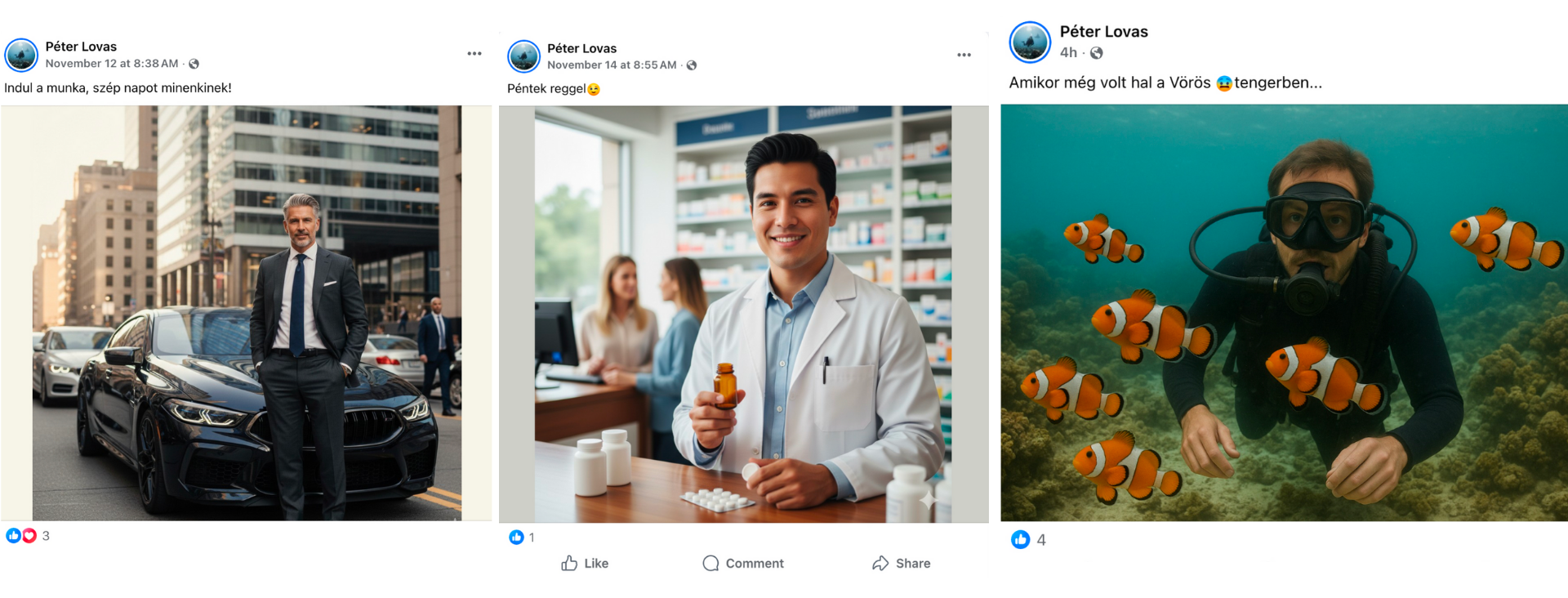
Zoltán did not have any fishing gear at hand, yet he somehow reeled in a mirror carp from the rippling Danube. We could have glossed over this inconsistency by assuming the fishing rod was left out of the frame. It is much harder to explain how someone can be a businessman with Caucasian features one day, a young pharmacist with slightly Asian features two days later, and then something entirely different again a few days after that.
This is a character building glitch that occasionally breaks the otherwise coherent storytelling of these personas. In some cases, though, a profile changes simply because it is “rewired.” Ágoston, for instance, began his online career as a historian, but the history program at ELTE may have seemed less than enticing, so he switched to fishing. He now has a thousand followers.
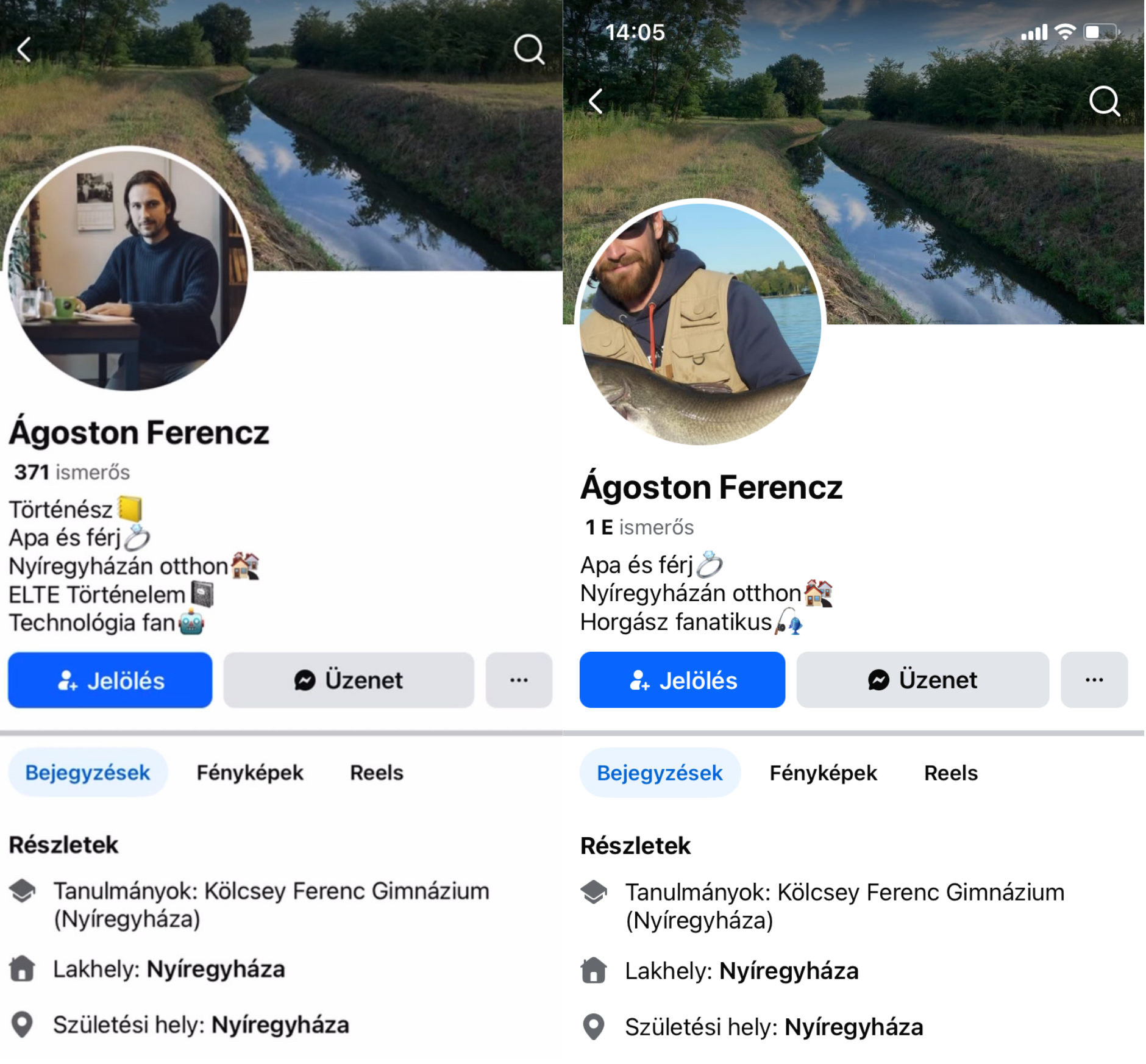
A few days ago this is what greeted visitors on his page, but by the time we wrote this article, the political content had disappeared.
Ágoston’s case shows how quickly we adapt to a visual style linked to artificial intelligence, only for a new one to emerge or replace it.
The profile photos in the network described in this article are no longer produced with the technology that became known around 2019 through ThisPersonDoesNotExist.com. That site relied on Nvidia’s open source StyleGAN and demonstrated how a generative model could create unlimited numbers of realistic yet entirely fabricated faces. A few years later the technology filtered into Hungarian public life as well; two years ago we reported on how profiles generated with ThisPersonDoesNotExist.com were used to support an opposition candidate in Újpest. But that program could produce only ID style, standard sized, front facing portraits, and over time the patterns in the faces it generated became easy to spot.
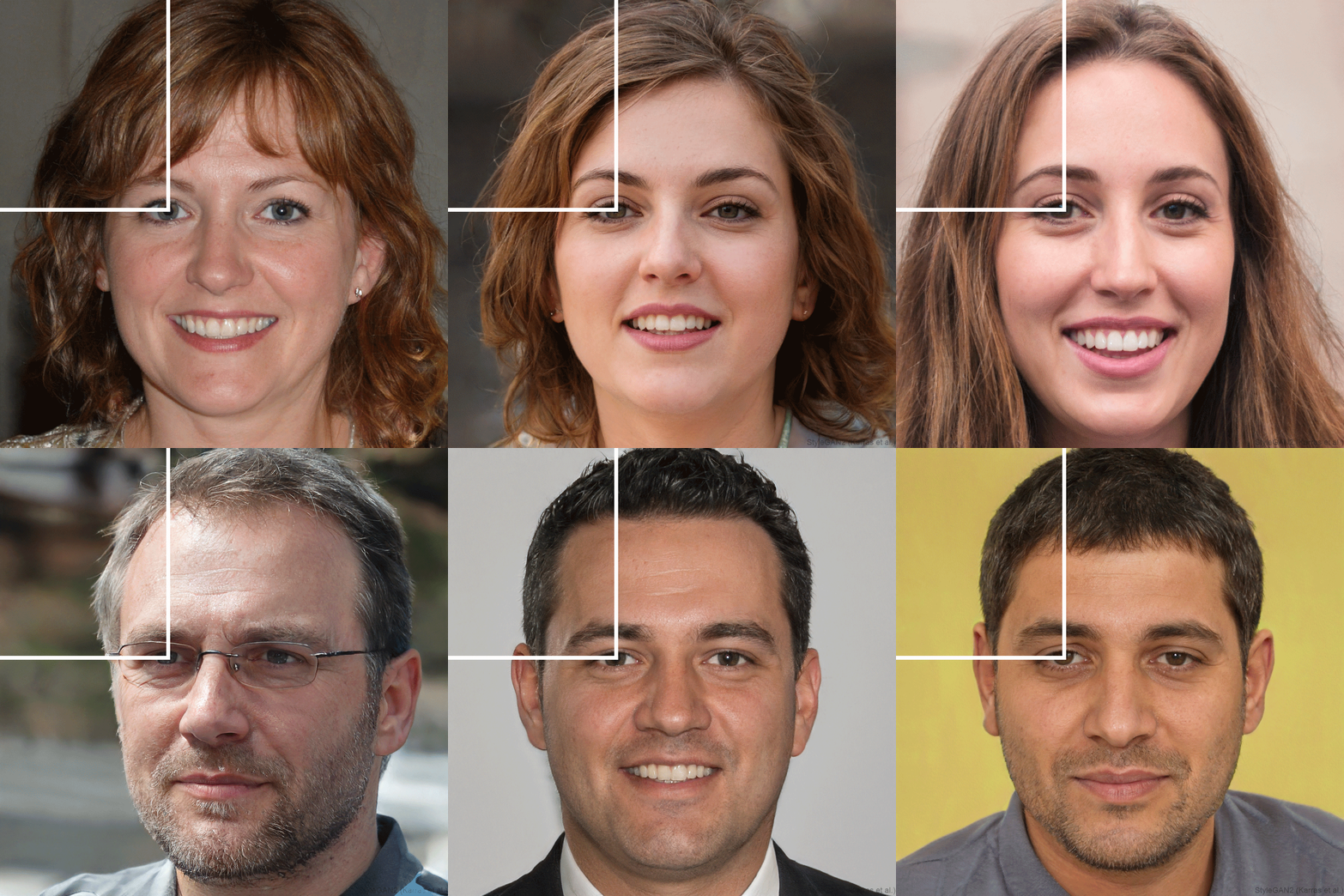
With the new generation of artificial intelligence systems such as Midjourney, ChatGPT, Grok, and Google Gemini, there is no point looking for mismatched earrings, crooked eyeglass temples, or pupils converging on a single spot. With text prompts or visual examples, almost any image can now be produced, and real photos can be refined as well. These tools generate not only faces but full scenes with detailed backgrounds.
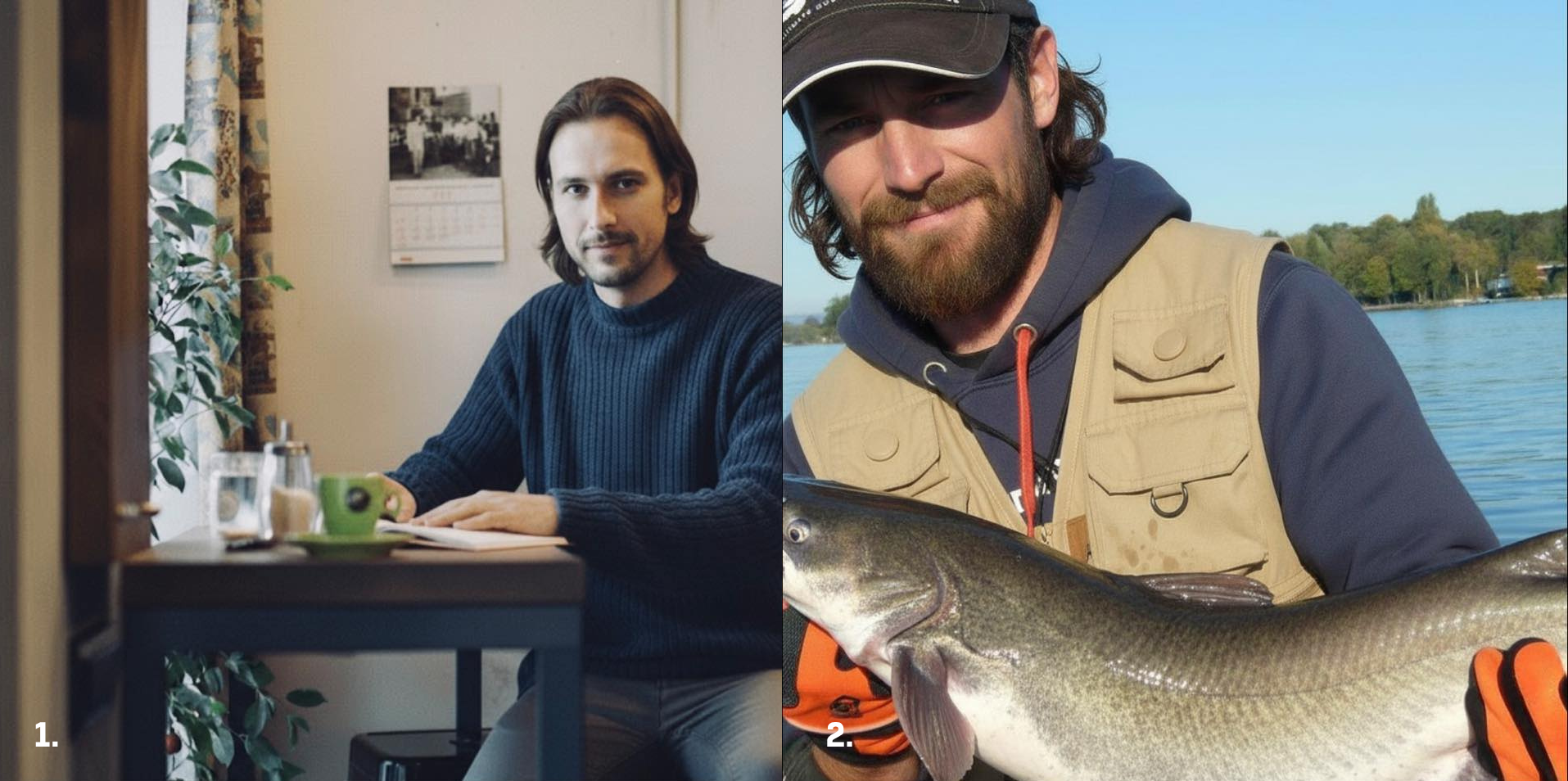
According to Google, the image on the left created for Ágoston’s profile was generated by its own AI assistant, Gemini. What gives away its artificial origin is not flaws but the opposite, an excess of perfection that makes it look as if it were taken in a professional studio.
The story of the second image is more complicated. After we ran it through a facial recognition tool, we located the original: a photo taken four years earlier of a man who teaches sport fishing on Lake Geneva.
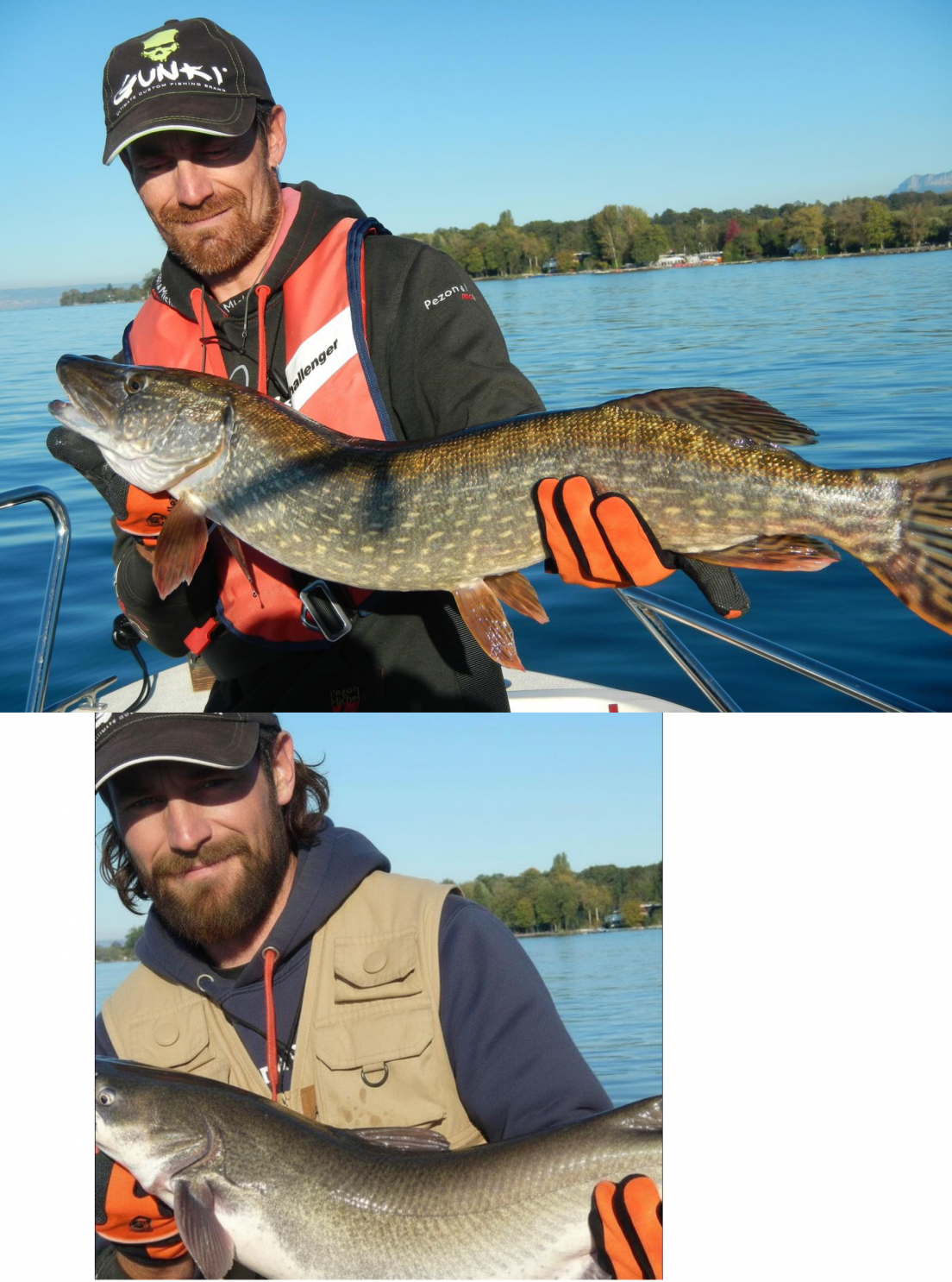
It is likely that the AI image generator did not create an entirely new portrait of a “fisherman” but used an existing photo as its base and modified it, giving the subject longer brown hair, for example, to fit Ágoston’s invented persona.
Although this profile picture would be difficult to identify as artificial at first glance, small errors can still reveal a picture's origin and offer clues for spotting AI generated images. These flaws or oddities often appear in the background, especially in built environments or in text placed on signs.
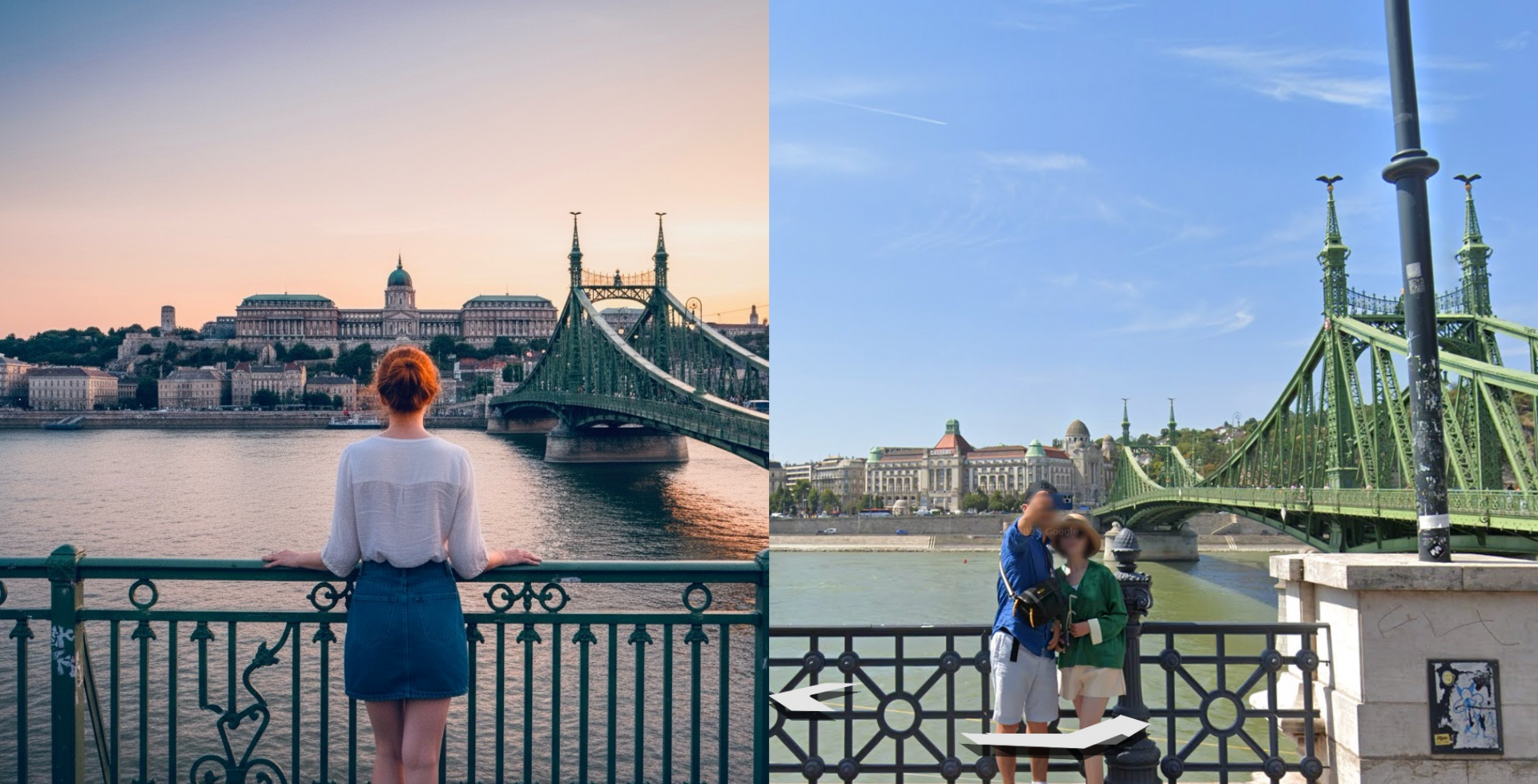
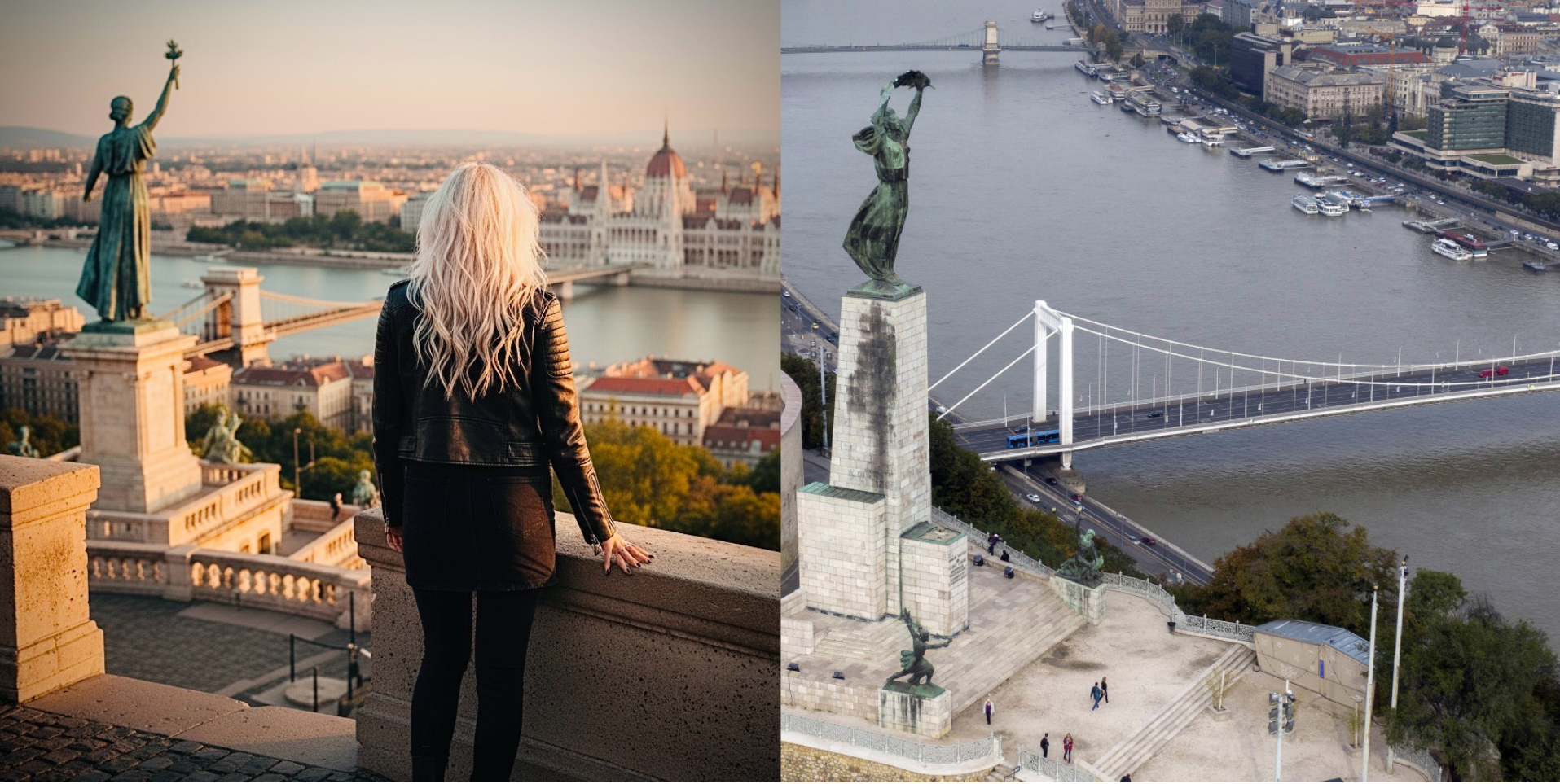
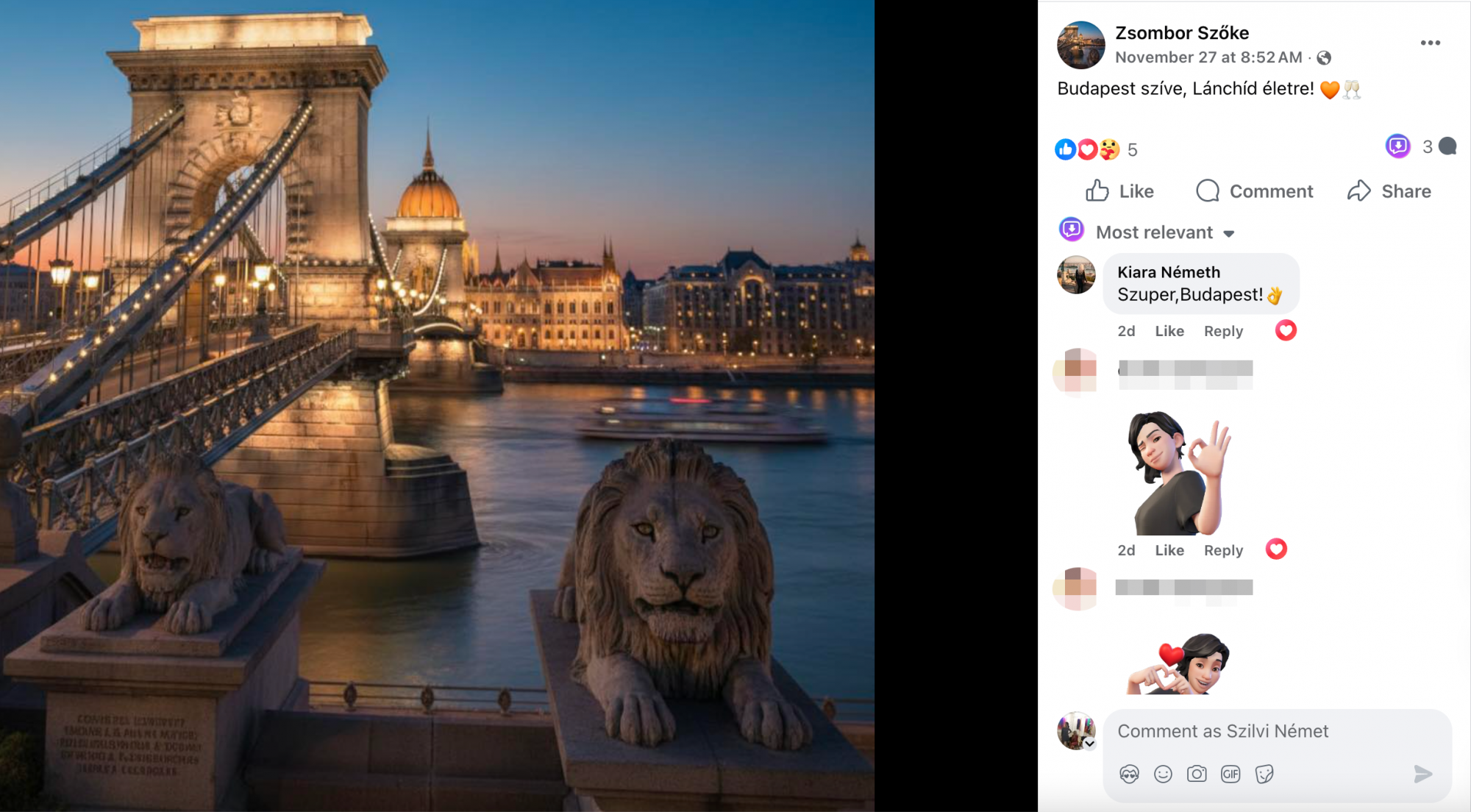
Emma, who according to her profile works at a government office and already has a thousand Facebook friends, posted a photo on October 28 in which she stands on the Pest embankment looking across the Danube. The view is striking, and commenters were fascinated, but because she is facing away from the camera, almost no one noticed the mistake: in reality, instead of the Liberty Bridge, the Chain Bridge runs toward the base of Buda Castle.
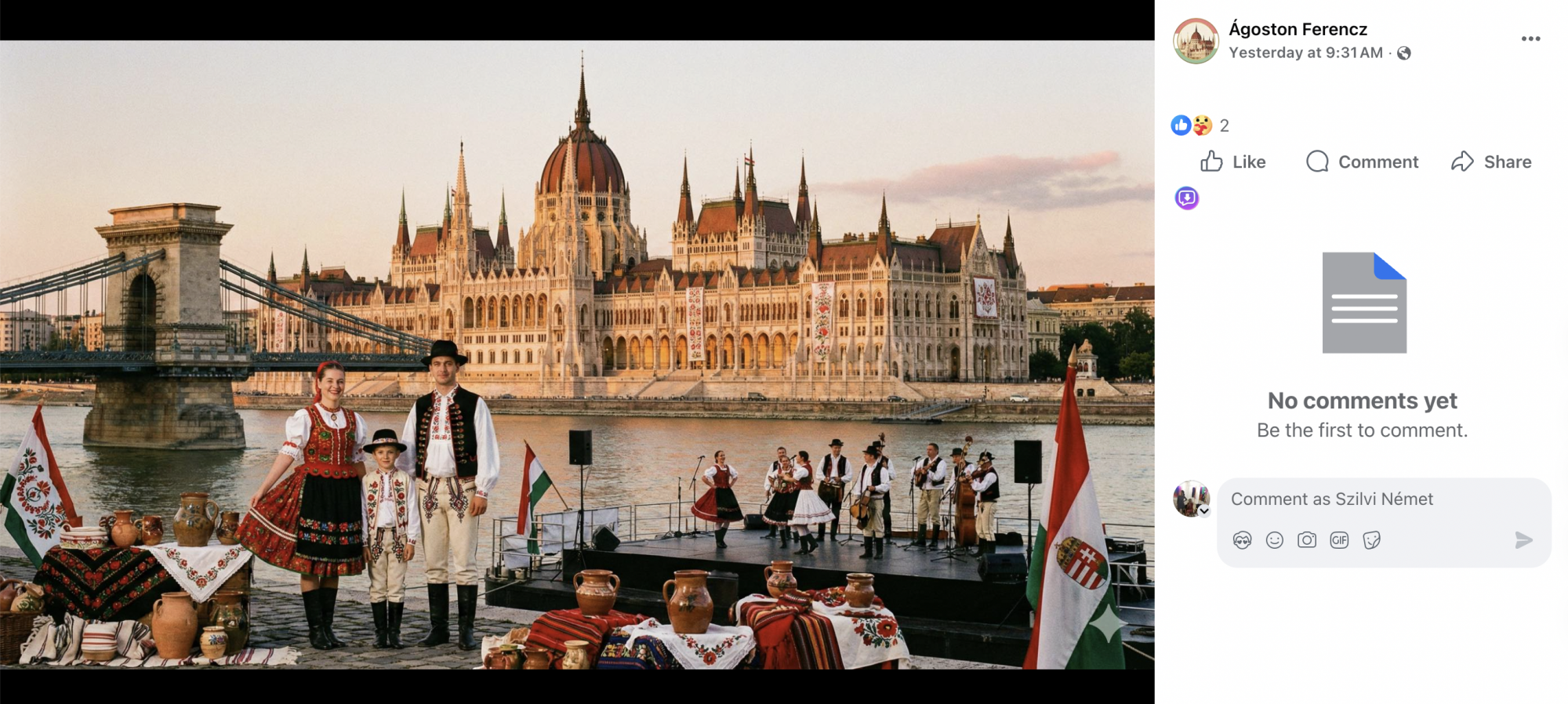
AI struggled with the Hungarian Parliament building as well. In Lili’s profile photo, not only do the details of the neo-Gothic structure differ from Imre Steindl’s original design, the program also hallucinated a three figure statue group in the middle of the square and failed to spell the country’s name correctly on the banner held by the demonstrators.
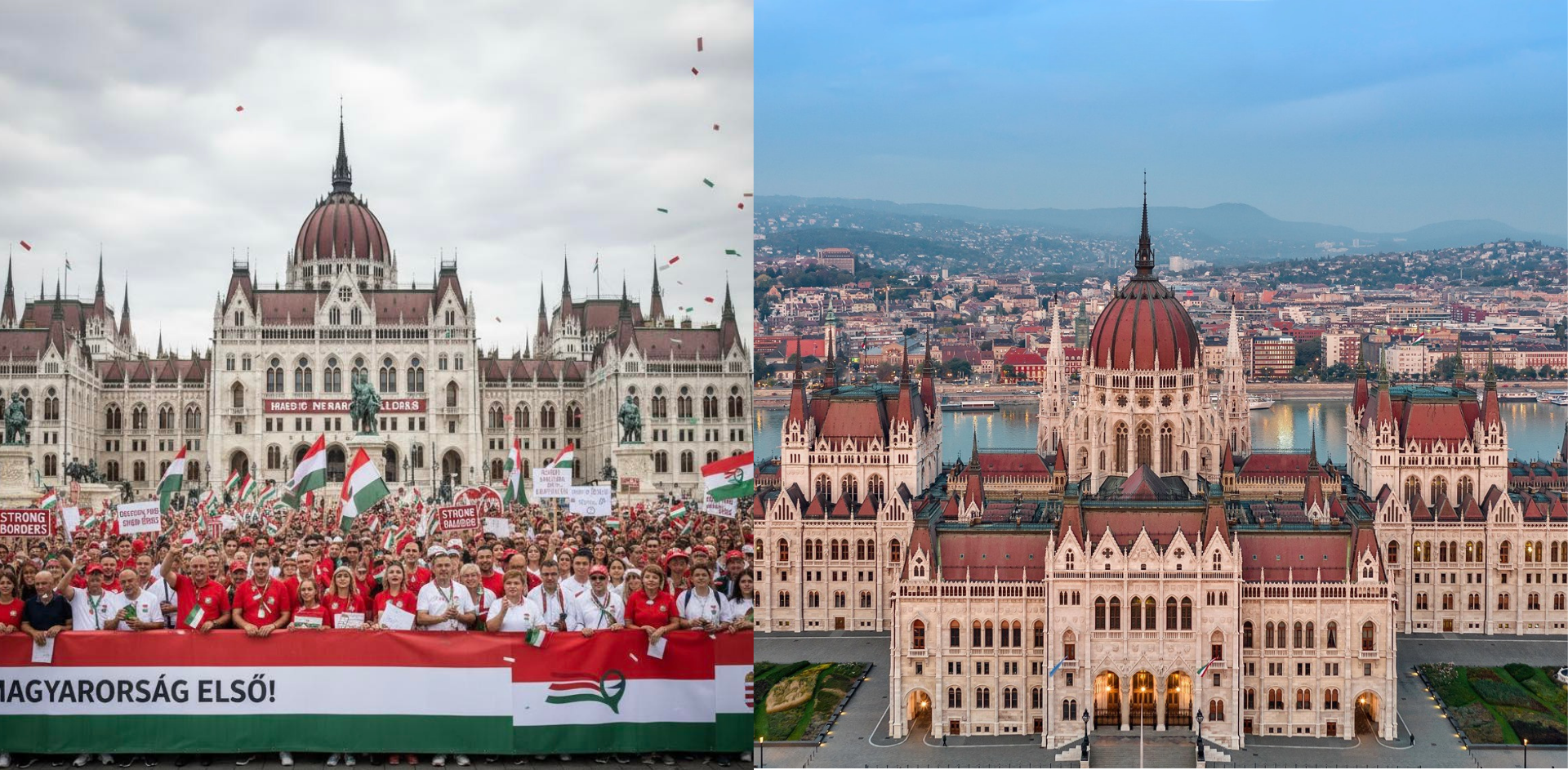
The most striking error appears in Kiara’s profile picture. The image compresses three Budapest landmarks, the Parliament, the Chain Bridge, and the Liberty Statue into a single vantage point, even though they can never be seen together this way in reality. The details are also wrong. The Chain Bridge practically runs into the Parliament, and the female figure atop the Citadella holds not a flower, but the palm branch that symbolizes victory and peace.
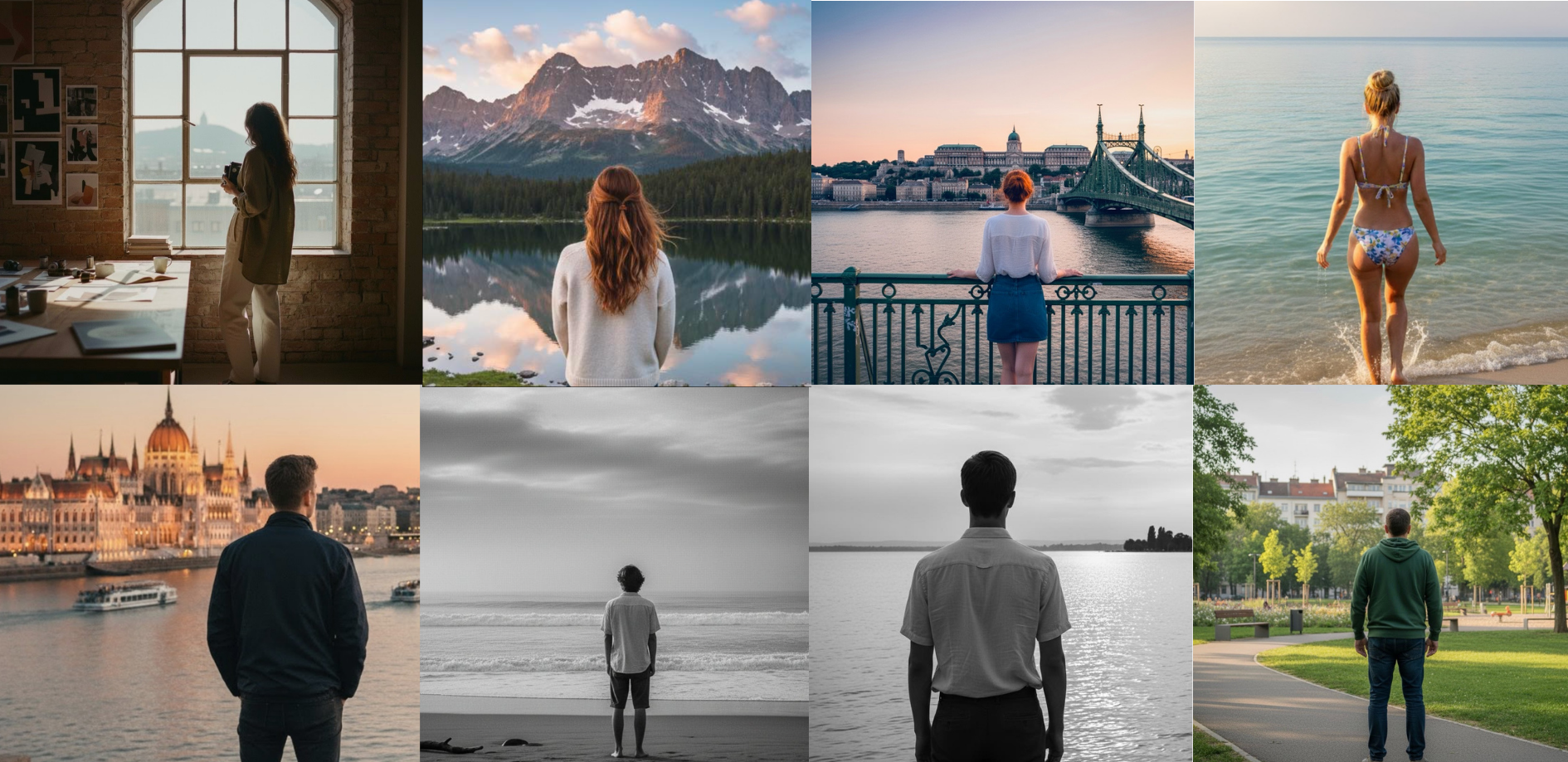
Botched cityscapes often draw attention to themselves through the figures placed in them, who typically stand with their backs to the camera. The composition serves not only an aesthetic purpose but a practical one. It is harder to spot flaws when the face is hidden.
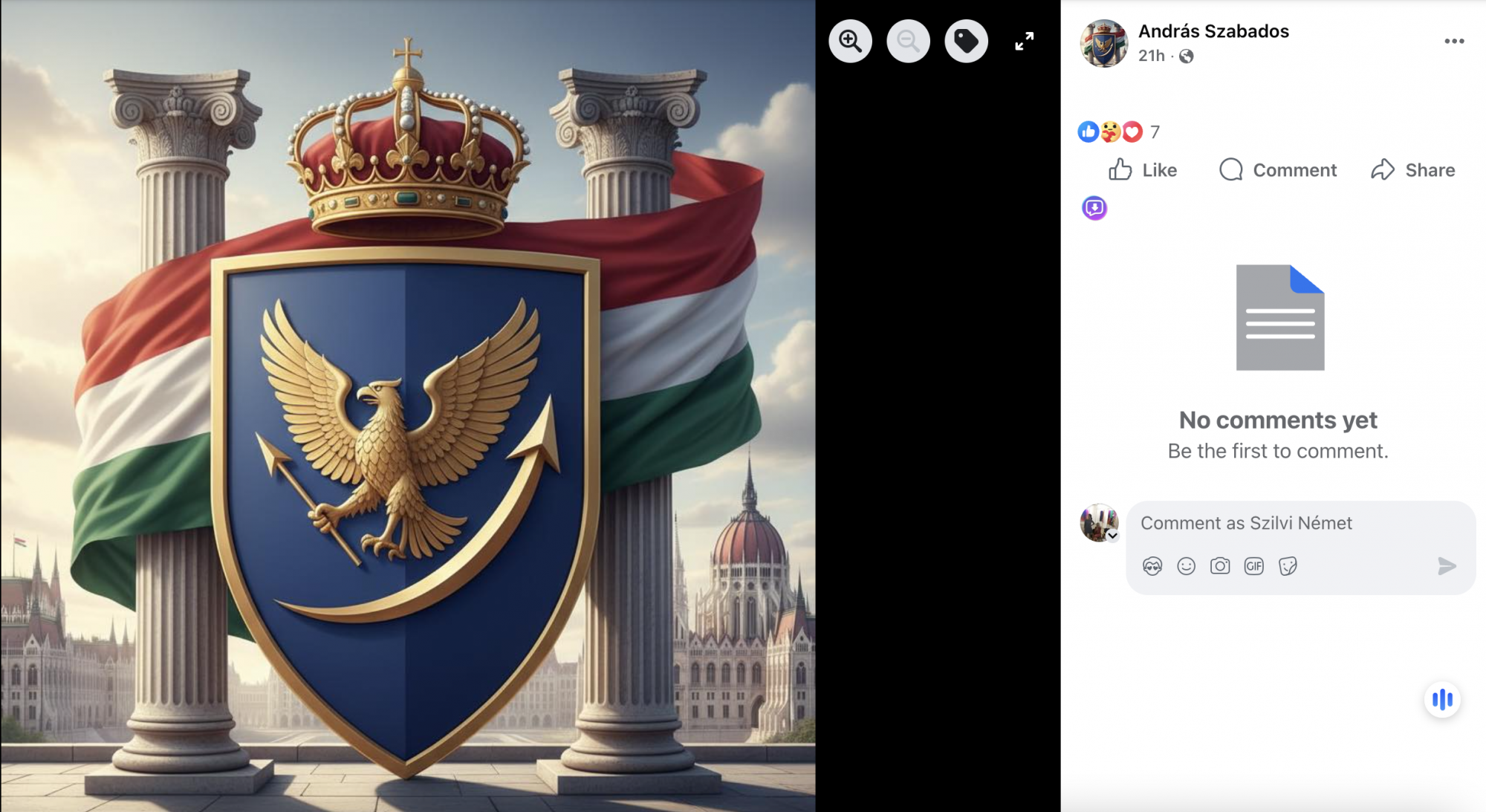
While we were reporting this story, numerous accounts replaced their profile or cover photos with real or imagined national symbols. Alongside the Parliament, the crown, the scepter, and the national flag, there were oddities here as well.
(Cover image: Bence Kiss/444)
A szerzőről
Német Szilvi
Újságíró, médiakutató. Az álhírek és a dezinformáció terjedését vizsgálja a közösségimédia-kutatás eszközeivel, valamint a technológiai platformok és a rejtőzködő médiaorgánumok szerepével foglalkozik.
Kövess minket!
Ne maradj le egy anyagunkról sem, kövess minket máshol is!