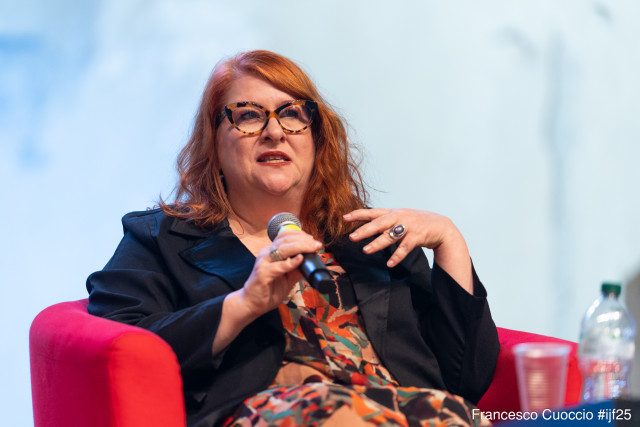
“Highly sexualized attacks are one of the oldest forms of warfare used to silence women”
2026. augusztus 31. 17:47
A combination of the mainstreaming of generative AI, the global rise of authoritarianism and the decline in democracy have increased the risks women in public life face online, says journalist and researcher Professor Julie Posetti in our interview.
Posetti told Lakmusz that the business model of tech companies instigates harm by design, and banning technologies is only a band-aid not a solution. She believes that we need appropriate safeguards that prevent harm at the source of the problem and politicians who are willing to stand up to the US tech companies that resist regulation.
As the lead author of a series of reports published by UN Women, she has surveyed women in the public sphere about their experiences with online attacks. We spoke with her about the rapid changes women must face in the online world, the role of AI in all of this, the troubling consequences of online violence, the responsibility of tech companies, and possible solutions.
The 2025 Tipping Point report argues that online violence against women in public life is creating the enabling environment to roll back their “hard-won right to gender equality and empowerment”. Are we really going backwards in history?
Ten years ago, I had high hopes that the internet itself and certain social media platforms might provide opportunities for the advancement of equality of women, minorities and other minoritized groups. I thought that these technologies could be democratizing. But the reality is that despite the protection of human rights online under international law, there is an anti-rights agenda influencing the tech companies in a way that maximizes their profit and power and doesn’t prioritize the protection of human rights.
The business model of these tech companies is tied to engagement and, by design, the technologies they build instigate harm. This means that hate, racism, sexism, misogyny and disinformation that generate more engagement, are more profitable. Therefore, the algorithmic drivers sending users in the direction of such content are designed to advance the profit of the companies.
On the other hand, there is a rising number of nefarious actors who try to promote male supremacy, white supremacy and the rollback of human rights – including gender equality – and the advances in equality that have been made in the past 70-80 years in this field. This combination is an incredibly toxic mix that’s poisonous to human rights, especially the rights of women and girls.
To illustrate the scale of the problem, I found a shocking number in the UN Women reports: 42% of the women journalists surveyed have experienced offline harm triggered by online violence, whereas 5 years ago it was only 20%. What role does AI play in this change?
From the research, we see that the threats against women journalists have become so much more dangerous when it comes to physical abuse triggered by online attacks. But these effects are not limited to women journalists. Women in public life in general have similar experiences – it’s a consistently bad pattern.
There are several problems with AI, but what really changed the landscape was when generative AI went mainstream at the end of 2022. It became much easier, cheaper and faster to produce much more believable content, including gendered disinformation.
Recently we’ve seen a real explosion in the deployment of ‘nudification’ apps: users take images of real women, and they use gen-AI technologies to strip the women naked, pose them in humiliating positions, simulate sexual assault and produce believable deepfake videos.
In combination with the rise of authoritarianism globally, the decline in democracy and an anti-rights agenda, it has really increased the risks women face online. Especially those who speak truth to male power, like journalists, activists and human rights defenders. They are increasingly under attack and subjected to sustained online violence.
You mentioned the global rise of authoritarianism. Recently published research surveyed women politicians in five countries, Czechia, Slovakia, Ireland, Germany and Hungary, and asked them about online attacks. The most online harm was experienced by Hungarian politicians. The report claims that one of the reasons for this high number is that gender-based (online) violence is embedded in the Hungarian political culture. Have you seen anything similar in other countries?
Absolutely, in numerous countries, especially where there is a dominant far-right agenda, an authoritarian government or a traditionally conservative cultural context. For example, in Brazil, under Jair Bolsonaro’s administration, we saw that online attacks were part of the ongoing violence directed against women journalists. We see a similar pattern occurring now in the United States. Misogynistic authoritarian political leaders target and attack women in public life, whether it is during a press conference, a public statement or an interview as we’ve seen with Donald Trump calling women journalists ‘piggy’ or telling them to shut up.
These abusive interactions license the online perpetrators’ misogynistic conduct and deepen the toxicity in the online environment. And at the same time, they expose women to greater risk of physical harm. This is a very dangerous trajectory from online harm to offline violence.
Your most recent report in the UN Women Tipping Point series talks about AI-assisted online violence and AI-assisted virtual rape. What exactly do these things mean?
One of the most shocking examples I’ve encountered involved Jess Asato MP, a British politician from the Labour Party, who is suing X currently because she was a victim of horrific AI-assisted online violence. She was subjected to nudification by users of Grok, the generative AI capability of X. She was not only stripped but also portrayed as if she had been rendered unconscious with chloroform so that she could be raped. Asato was targeted because she was campaigning for a ban on nudification apps. Her case really illustrates where we’re at right now in the area of AI-assisted virtual rape.
You mentioned X. Is that the platform where you’ve found the most online violence against women, or are there others as well?
I think X and Grok are at the forefront in this regard. Online violence on X is just so prolific, and very accessible for the mainstream. Late last year they released the models that were allowing Grok to ‘nudify’ images of women and children, and these tools were seamlessly integrated into the distribution platform, X, so the content could be created and immediately distributed through X at scale. This made the risk much greater and therefore more concerning.
When the UK government demanded that Grok and X do something about the problem, Elon Musk’s response was to say: we will restrict access to these tools and distribution mechanisms, and we will allow only those subscribers with blue ticks to use them.
In other words, they’d continue to allow the exploitation, but charge perpetrators for access to the tools.
There have been more and more attempts by individual governments, like the UK, and the EU to ban these apps, but we must keep explaining how damaging these technologies are – by design: they cause reputational harm but also have the potential to spill offline and create an increased risk of physical violence.
Physical violence is one of the harshest consequences of these online attacks but there are more, such as the ill effect on women’s mental health and the increase in self-censorship both online and in the workplace.
In addition to causing physical harm, there are incredibly damaging consequences, particularly for freedom of expression and women’s mental health. Self-censorship is an increasing problem, limiting women’s participation in democratic deliberation which is very harmful to the fabric of democracy. It is particularly alarming that the number of women journalists who practice self-censorship has increased by 50% since 2020 because Big Tech companies, employers, and governments have failed to secure a safe online environment in which they can work.
The statistics on mental health are also devastating: A quarter of the women surveyed in 2025 were diagnosed with depression and anxiety as the result of online violence they experienced. That’s horrific. And there is the economic impact as well, because such diagnoses also limit their ability to work. Highly sexualized attacks against women are one of the oldest forms of warfare. Now, this form of violence in the digital realm is being used to silence women and push them out of public spaces – online or offline. And when it comes to women journalists, the effects of attacks designed to undermine individual credibility include undermining public trust in their news outlet and in journalism in general.
Women in public life are generally targeted to a tremendous extent, but this does not apply only to those who have public profiles. Women who are going through a breakup, for example, are also at risk – when their partner decides to use these technologies to retaliate.
We must respond to these problems with much greater determination through regulation and legislation, and we need political leaders with the political will to stand up to the predominantly US-based tech companies, and to stand up to an administration that is willing to sacrifice the rights of women, minorities and other minoritized groups for the sake of these companies’ profits.
Do you think that banning nudification apps, as it’s been happening in the European Union, can be a good direction and an effective tool to solve the problem?
I understand why bans have been instituted, and that they are intended to create immediate relief from harm, but bans are only a band-aid. It’s only a way to address harm after it has occurred.
The best way to ensure that such technologies don’t continue to proliferate is to require the companies to do human rights testing on technologies prior to release, and to prevent the development of such technologies which are very clearly designed to abuse, to humiliate.
We wouldn’t be able to produce and release kitchen appliances that are at risk of blowing up or, by default, designed to cause harm. So, why do we still allow these companies to produce technologies without the appropriate safeguards? If governments and the EU are prepared to ban apps once it’s been proven that they cause harm, why can’t they also demand the prevention of these harms by insisting on appropriate mechanisms and approvals – just as they have done with regulations governing buildings or other forms of development?
That’s what we need to address, rather than trying to impose fines on companies run by trillionaires and billionaires. Because very few fines will ever be significant enough to impede them.
Cover photo: Francesco Cuoccio / International Journalism Festival
A szerzőről

Fülöp Zsófia
2023 májusától a Lakmusz újságírója, korábban 9 évig a Magyar Narancsnál dolgozott, főként egészségügyről, szociális ügyekről és marginalizált csoportokról írt. Az oxfordi Reuters Institute ösztöndíjasaként a romák médiareprezentációját kutatta.
Kövess minket!
Ne maradj le egy anyagunkról sem, kövess minket máshol is!
Ajánlott cikkeink

Rétvári Bence a meddő házaspárok lehetőségeit félti az azonos neműek örökbefogadásától, de a számok nem őt igazolják
Megnyílt egy új csatorna az LMBTQ-ellenes gyűlöletbeszéd jelentésére, az ide érkező panaszokat az online platformoknak is komolyan kell venniük